The short answer to concrete versus pavers is this: a poured concrete patio costs less to build and goes in faster, while a paver patio costs more upfront but lasts longer, survives Chicago winters better, and repairs without leaving a scar. If your only goal is the lowest price this season, concrete wins. If you want the surface that still looks good in twenty years and does not crack when the ground heaves, pavers are usually the better long-term buy in our climate. This guide compares the two across the seven decisions that matter most, cost, lifespan, winter performance, repair, maintenance, resale, and install time.
R & G Almanza Landscape Inc has built both poured concrete and paver patios across Skokie, Chicago, and the North Shore since 1999, and the freeze-thaw math here is different from the national averages you read online. Every figure below is attributed to published cost and industry data, with the local factors that change the answer for a Chicago homeowner called out where they matter.
Concrete vs Paver Patio: Quick-Verdict Comparison
Here is the head-to-head at a glance. Concrete takes the first two rounds on price and speed, pavers take the rest on durability and repair. The right choice depends on which of these columns matters most to you.
| Dimension | Poured / Stamped Concrete | Paver Patio | Edge |
|---|---|---|---|
| Upfront cost | $6 to $30 / sq ft installed | $8 to $55 / sq ft installed | Concrete |
| Lifespan | 20 to 30 years (stamped 15 to 25) | 30 to 50+ years | Pavers |
| Winter / freeze-thaw | Rigid slab, prone to cracking | Flexible units, move with heave | Pavers |
| Repair | Mud-jack or replace the slab, visible patch | Lift and relay single units, no scar | Pavers |
| Maintenance | Reseal stamped every 2 to 3 years | Refresh joint sand, occasional sealer | Roughly even |
| Resale value | Adds value, seen as standard | Adds more, seen as premium | Pavers |
| Install time | Faster to pour, then must cure | Slower to lay, usable once compacted | Concrete |
Costs are published installed ranges from Angi and HomeGuide, spanning plain poured concrete at the low end to premium stamped concrete and Chicagoland professional paver installs at the high end. Treat them as planning ranges, not quotes.
Upfront Cost: Concrete Wins the First Invoice
On the day you write the check, concrete is the cheaper patio. A plain poured concrete slab runs about $6 to $15 per square foot installed according to HomeGuide and Angi, and decorative stamped concrete runs $8 to $30 per square foot depending on the pattern and color. A paver patio starts higher: Angi puts installed pavers at roughly $8 to $25 per square foot nationally, and Chicago-area landscaper guides commonly quote $25 to $55 per square foot for a fully engineered professional install. The gap at the top end reflects the paver base, which has to be deeper and better compacted to survive our winters.
| Surface | Installed cost (published) | Source |
|---|---|---|
| Poured (plain) concrete | $6 to $15 / sq ft | HomeGuide, Angi |
| Stamped concrete | $8 to $30 / sq ft | HomeGuide, Angi |
| Paver patio (national) | $8 to $25 / sq ft | Angi |
| Paver patio (Chicagoland pro install) | $25 to $55 / sq ft | Chicago-area landscaper guides |
These are the numbers we use consistently throughout this comparison. Cost is the one dimension where the two surfaces are not close, so if budget is the deciding factor, poured concrete is the answer. For a full paver patio cost breakdown by material, size, and cost driver, our full paver patio cost breakdown works through the numbers in detail. What the first invoice hides, and what the rest of this guide covers, is the cost per year of use, where the ranking often flips.
Lifespan: How Long Each Patio Lasts
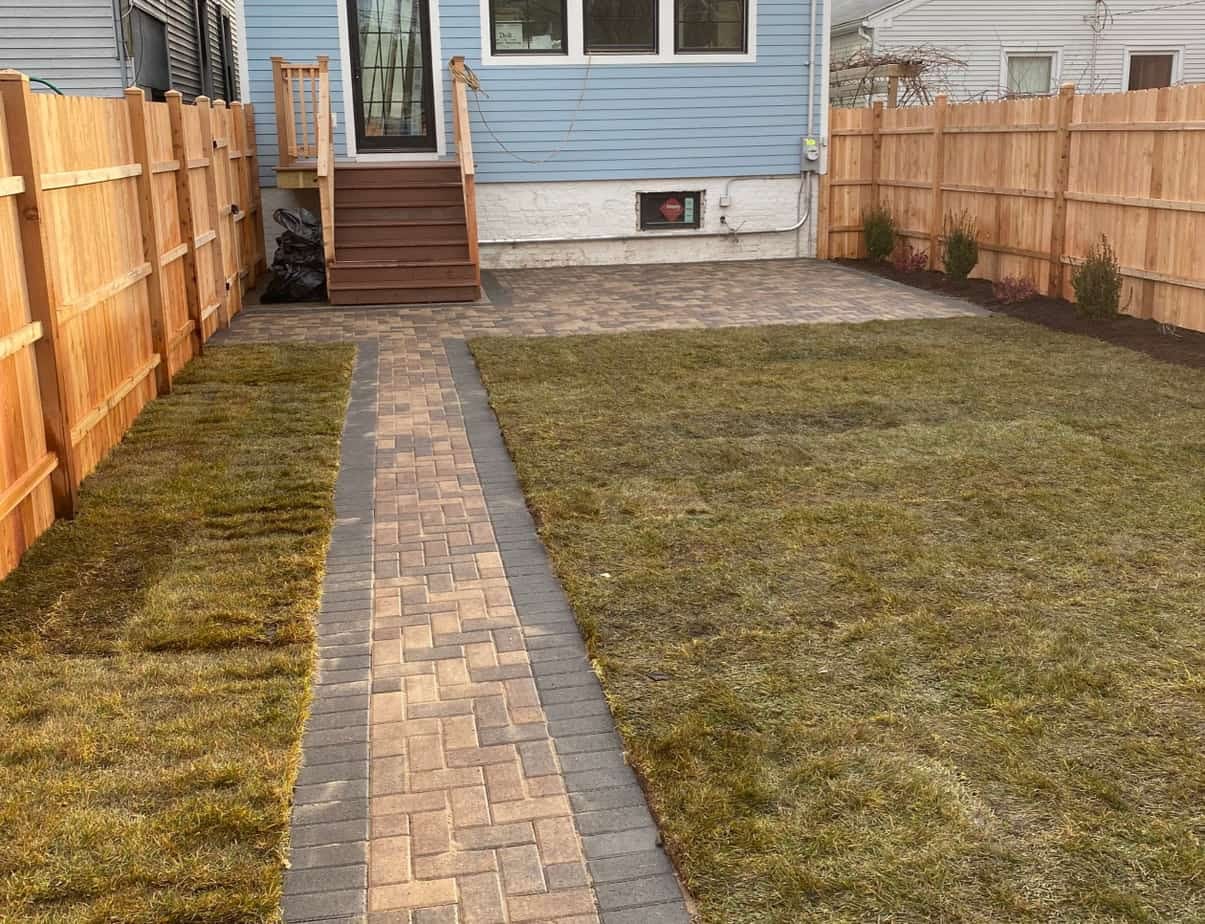
Pavers last longer, and it is not close. A well-built paver patio lasts 30 to 50 years or more, while a poured concrete patio generally lasts 20 to 30 years, and stamped concrete sits lower at 15 to 25 years because its decorative surface layer wears and the sealer has to be renewed. The reason is how each surface handles ground movement. A concrete patio is a single rigid slab, strong under weight but unforgiving when the soil beneath it expands, contracts, or settles. Pavers are individual units set over a flexible compacted base, so the surface flexes with the ground instead of fighting it.
Spread the cost over those lifespans and the value picture changes. One published comparison framed it this way: a concrete patio that lasts about 18 years works out to roughly $222 per year, and a paver patio that lasts 40 years works out to roughly $225 per year, nearly the same annual cost, except the pavers look better for the whole run and the concrete is due for replacement while the pavers are barely middle-aged. In a climate as hard on hardscape as ours, lifespan is not an abstract number, it is how many winters the surface has to survive.
Winter Performance: Freeze-Thaw Cracking and De-Icing Salt
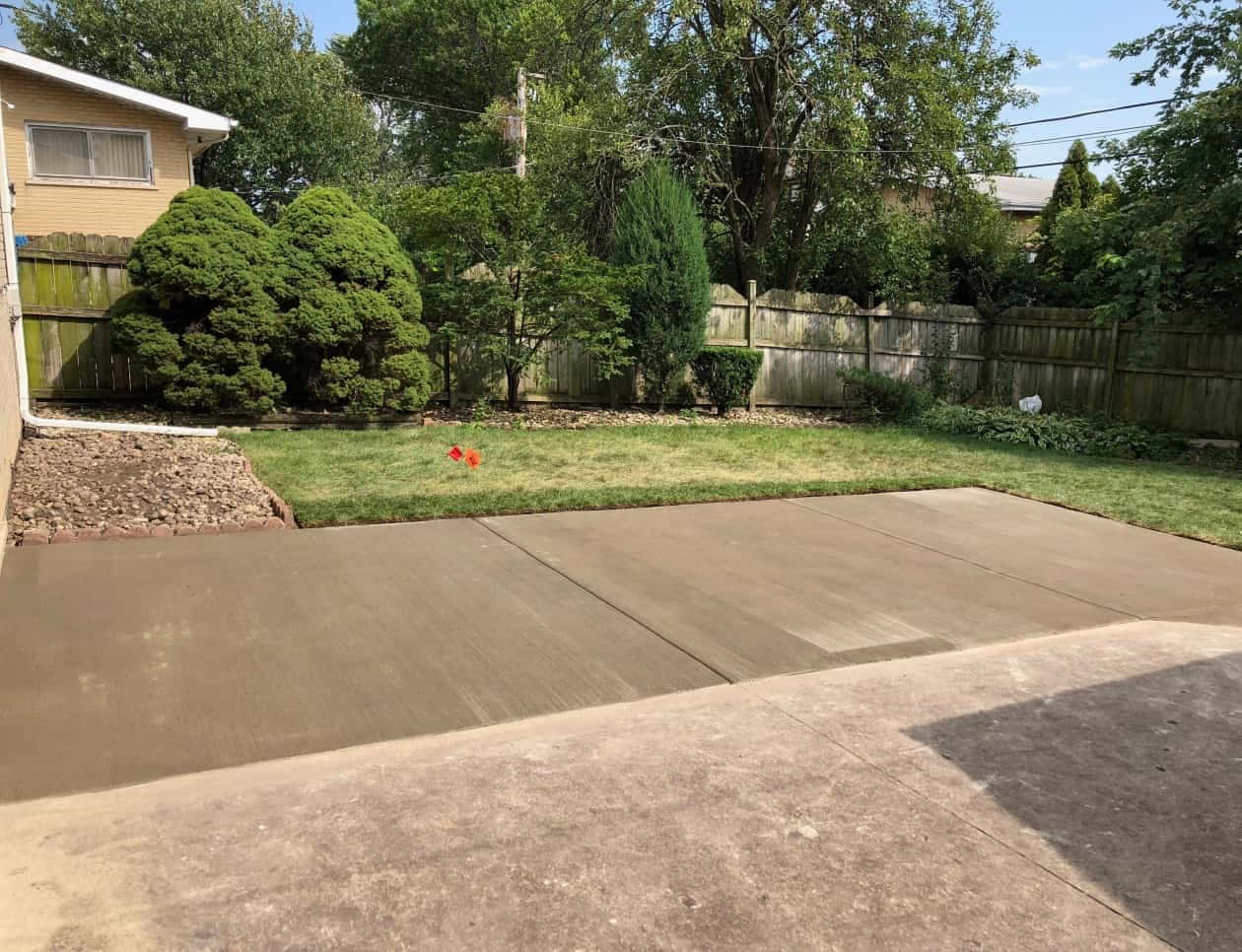
This is the dimension where Chicago tips the scale toward pavers. Our region cycles through dozens of freeze-thaw events each winter, and each one moves the ground. When soil moisture freezes it expands upward, a movement called frost heave, and a rigid concrete slab has only two ways to respond: hold and crack, or lift and crack. Contractors pour control joints, the straight grooves you see cut into a slab, specifically to steer where those cracks form, but control joints manage cracking, they do not prevent it. Once a crack opens in a poured or stamped slab it tends to widen and is difficult to hide. A paver patio has a joint between every unit, so instead of cracking it simply shifts with the frost and settles back, which is why pavers handle freeze-thaw by a wide margin.
De-icing salt is the second winter problem, and it hits concrete harder. When you salt a concrete slab, salt water soaks into the pores, and the calcium chloride reacts with the calcium hydroxide in the concrete to form an expanding compound that cracks the slab from the inside out. The visible result is scaling, where the top layer flakes off, and spalling, where corners and edges break down. Pavers are factory-made and dense, so they resist that surface flaking far better, though even pavers do best with sand or grit for traction rather than heavy rock salt. If your patio is going to see a shovel and an ice-melt bag every winter, that salt tolerance is a real, and often overlooked, point in the pavers column.
Repair Economics: Mud-Jacking a Slab vs Lift-and-Relay Pavers
When something goes wrong, the two surfaces repair in completely different ways, and this is where a paver patio quietly earns back its higher price. A cracked or sunken concrete slab has two fixes. You can mud-jack it, pumping material underneath to raise a settled section, which runs about $3 to $9 per square foot with contractor minimum job fees commonly $300 to $700 according to Angi and HomeGuide. Or you replace the slab, at $8 to $15 per square foot and higher once you add demolition and disposal. Mud-jacking can level a slab, but it cannot erase a crack, so a repaired concrete patio usually still shows where the damage was.
A paver patio repairs by lift-and-relay: you pull up the affected pavers, re-level the base underneath, and reset the same units, often with no visible patch at all. If a single paver stains, chips, or a tree root lifts a corner, you fix that spot alone and leave the rest untouched. Because the repair reuses the original pavers and touches only the failed area, it is both cheaper on a small failure and invisible when done, while the equivalent concrete repair means living with a patched or mismatched slab. Over a 30-year ownership window in a heaving climate, the repair method matters as much as the install.
Maintenance: Sealing, Joints, and Upkeep
Maintenance is closer to a tie, but the work is different. Stamped concrete carries the heavier routine: its decorative surface should be resealed every 2 to 3 years at roughly $1.50 to $2.50 per square foot each time, and skipping it lets the pattern fade and the surface grow more vulnerable to salt and freeze damage. Plain poured concrete needs less, mostly occasional cleaning and crack-filling as it ages.
A paver patio trades resealing for joint care. The polymeric sand swept between the pavers hardens into a firm but flexible joint that locks the units together and limits weeds, and it needs a refresh every few years, plus an optional sealer to deepen color. The difference is that concrete maintenance slows the surface toward eventual replacement, while paver maintenance keeps a repairable surface in good shape for decades.
Drainage and Permeability on Chicago Clay Soils
Much of the Chicago area sits on heavy clay soil that drains slowly, and that changes how a patio handles water. A poured concrete slab is impermeable, so every drop of rain and snowmelt runs off the surface. That runoff has to go somewhere, which means a concrete patio usually needs deliberate grading, and sometimes a drain, so water moves away from your foundation rather than pooling against it. A standard paver patio also sheds most surface water, but permeable paver systems take it further: open joints and an open-graded stone base let water pass through the surface and soak into the ground instead of running off. On a tight clay lot where standing water is a recurring problem, that permeability can be a real advantage, and it pairs naturally with proper site grading and drainage work. Whichever surface you choose, drainage is not an upsell in our climate, it is what keeps meltwater away from the house.
Resale Value and Curb Appeal
Both patios add resale value, but buyers read them differently. According to HomeLight, a professionally built patio can return roughly 60 to 90 percent of its cost at resale when it fits the home and landscape. Within that, real estate professionals tend to view a paver patio as the premium surface and a plain concrete slab as the standard expectation, so pavers generally add more to a home's perceived value than an equivalent poured slab. Stamped concrete narrows the appearance gap because it can mimic brick or stone, but it carries concrete's cracking and resealing tradeoffs underneath the finish. If the patio is part of a wider hardscaping services plan, the material you choose sets the tone a buyer sees first.
Installation Time and Disruption
Concrete is the faster install, with a catch. A poured slab goes down in a single pour once the site is excavated and formed, but fresh concrete then has to cure before it can take furniture and foot traffic and reaches full strength over several weeks, so faster to build does not mean faster to use. A paver patio takes longer to lay because every unit is set and compacted by hand, yet once the final compaction and joint sand are done the surface is ready to use immediately, with no curing wait. For most homeowners the difference is a matter of days, and it matters most when you need the space usable by a specific date.

Which Is Right for You?
The best patio depends on which tradeoff you are willing to make. Here is how the decision usually breaks down for Chicago-area homeowners.
- Choose poured concrete if budget is the deciding factor, you want the lowest upfront price, and you are comfortable with a surface that may crack over time and will likely need replacement in a couple of decades. It is a sound value pick for a simple, low-traffic patio.
- Choose stamped concrete if you want a decorative brick or stone look at a lower price than pavers and you are willing to reseal it every few years to keep it looking right. Know that it still cracks like a slab and repairs like a slab.
- Choose a paver patio if you plan to stay in the home, want the longest lifespan, need the surface to shrug off freeze-thaw and de-icing salt, and value a repair that leaves no scar. It costs more today and pays that back over the life of the patio.
- Lean pavers for a heaving or wet lot. On the clay soils common across Skokie and the North Shore, the flexibility and permeability of pavers are worth more than they are in a mild, well-drained climate.
There is no single right answer, only the right answer for your yard, your budget, and how long you plan to enjoy the space. A look at your soil and drainage on site is what turns this comparison into a decision.
Concrete vs Paver Patio FAQ
Is a paver patio better than concrete in Chicago?
For most Chicago-area homes, yes, if you can afford the higher upfront cost. Our freeze-thaw winters and heavy clay soils are exactly the conditions that crack a rigid concrete slab, and pavers are built to flex with that ground movement instead of cracking. Concrete is still the better pick when the lowest upfront price is the priority.
Which lasts longer, concrete or pavers?
Pavers last longer. A well-built paver patio lasts 30 to 50 years or more, while a poured concrete patio generally lasts 20 to 30 years and stamped concrete 15 to 25 years. Pavers move with the ground and repair unit by unit, which is why they outlast a slab that has to crack or be replaced.
Is concrete or pavers cheaper for a patio?
Concrete is cheaper upfront. Plain poured concrete runs about $6 to $15 per square foot installed and pavers run higher, from $8 to $25 per square foot nationally and $25 to $55 per square foot for a Chicagoland professional install, per Angi and HomeGuide data. Over the full lifespan, the annual cost of the two surfaces ends up much closer because pavers last so much longer.
Do concrete patios crack more than pavers?
Yes. A concrete patio is a single rigid slab, so frost heave and settling tend to crack it, and control joints only steer where the cracks appear rather than preventing them. A paver patio has a joint between every unit, so it shifts and resettles with the frost instead of cracking.
Can you repair a concrete patio versus a paver patio?
Both can be repaired, but differently. A sunken concrete slab can be mud-jacked back into place for roughly $3 to $9 per square foot, or replaced at $8 to $15 per square foot, and a crack usually stays visible. A paver patio is repaired by lifting the affected pavers, re-leveling the base, and resetting the same units, often with no visible patch.
How does de-icing salt affect concrete and pavers?
De-icing salt is harder on concrete. Salt drives moisture into the slab and reacts with the concrete to cause surface scaling and spalling over time. Pavers are denser and more salt-tolerant, so they resist that surface flaking better, though sand or grit for traction is still gentler on any patio than heavy rock salt.
Does a paver patio add more home value than concrete?
Generally yes. Published data puts patio ROI at roughly 60 to 90 percent, and buyers tend to see pavers as a premium surface and plain concrete as standard, so a paver patio usually adds more perceived value than an equivalent slab. Stamped concrete closes some of the appearance gap but keeps concrete's cracking and resealing tradeoffs.
Compare Concrete and Paver Patios for Your Yard
This comparison gets you to the right short list, but the deciding factors, your soil, your drainage, and how the space will be used, live in your own backyard. R & G Almanza Landscape Inc has installed both poured concrete and paver patios across Skokie, Chicago, and the North Shore since 1999, with bases built for our freeze-thaw winters. If you want help weighing concrete against pavers for your specific project, contact us for paver patio installation options, or call our Skokie team at (847) 869-8584 to talk through what fits your yard and budget.