A French drain is a sloped trench holding a perforated pipe in washed gravel, wrapped in filter fabric, dug to intercept water moving below the surface and carry it somewhere safe. HomeGuide puts the usual residential trench at 12 to 24 inches deep, at least 12 inches wide, and 2 to 5 feet out from the foundation, sloped at least 1 percent. In the Chicago area, US Waterproofing prices an exterior yard or curtain drain at $10 to $35 per linear foot, an exterior perimeter drain at the foundation at $25 to $50 per foot, and an interior basement system at $58 to $70 per foot; Angi's national spread is $10 to $100 per linear foot with a $9,250 average project. Depth, slope, and the outlet decide whether the drain works at all, and if the real problem is the shape of the whole lot rather than one wet strip, it is yard grading and drainage work instead.
Below: the trench specification, the slope everything depends on, where the water is allowed to go, and what it costs per foot on Chicago clay. If you are still deciding whether a trench is the right fix at all, our comparison of yard drainage solutions weighs it against regrading, downspout extensions, and dry wells first.
What a French Drain Is, and What It Is Not
Half the confusion in drainage quotes is vocabulary. A French drain moves water already in the soil; a trench drain catches water sitting on a hard surface; a dry well stores water with nowhere to go. They combine well, but they are not substitutes, and the rates below are not comparable across rows. Clemson Cooperative Extension draws the practical line in one sentence: if you are not installing a French drain, gravel is not needed at the bottom of the trench.
| System | What it does | Attributed cost (2026) |
|---|---|---|
| French drain | Perforated pipe in a buried gravel trench, carrying subsurface water to an outlet | $10–$35/ft in the yard, $25–$50/ft at the foundation (US Waterproofing) |
| Curtain drain | Shallower interception drain, 2 feet or more deep, set upslope of the wet area | $10–$35/ft, $1,500–$8,800 (HomeGuide) |
| Trench or channel drain | Grated surface channel catching sheet flow off paving | $30–$100/ft, to $150/ft complex (HomeAdvisor) |
| Dry well | Storage, not conveyance | $1,600–$4,800 (HomeAdvisor) |
A second naming problem is specific to this market. US Waterproofing notes Chicago contractors use "French drain," "drain tile," and "footing tile" almost interchangeably, which is why one phrase covers both a $2,000 yard project and a $10,000 basement one. In its original sense a French drain sits 8 to 24 inches down and works by gravity; drain tile sits at the foundation footings, manages groundwater pressure from below, and almost always connects to a sump pump. Where the fix is the shape of the whole lot, the work starts from site grading and drainage plans rather than a trench.
Trench Depth, Width, and Distance From the House
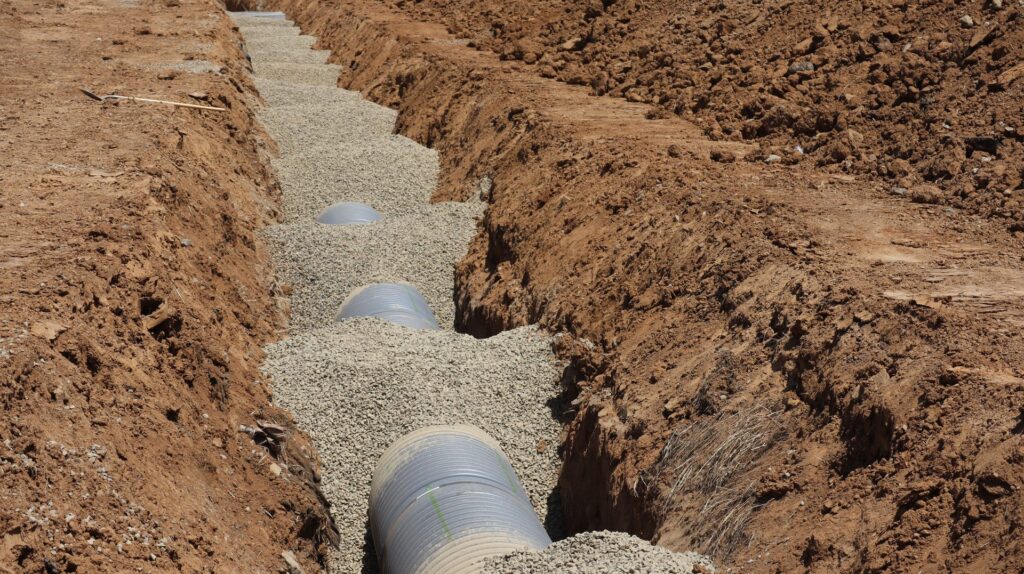
HomeGuide's residential specification is 12 to 24 inches deep, at least 12 inches wide, and 2 to 5 feet from the foundation in most cases. US Waterproofing describes the same work in the field: yard drainage usually stays 1 to 2 feet below the surface, and foundation-adjacent drains go deeper. HomeAdvisor puts a curtain drain at about two feet deep beside the foundation.
Depth is the biggest labor multiplier: HomeAdvisor notes digging deeper to set the pipe raises cost with the labor, which is why shallow and curtain drains price below deep ones. HomeGuide puts trenching alone at $5 to $12 per linear foot. Length follows the problem, not the lot — US Waterproofing puts a full basement perimeter at 100 to 150 linear feet and a yard curtain drain at 30 to 50 feet — so any quote should state the footage.
What Goes in the Trench: Pipe, Gravel, and Fabric
A 3- to 4-inch perforated pipe suits most residential applications, per both Angi and HomeGuide. HomeGuide prices corrugated pipe at $1.00 to $3.00 per foot and PVC at $1.20 to $5.00: corrugated bends around curves, PVC survives a plumber's snake on deep footing drains.
The fabric decision matters more than most homeowners expect. A pipe sleeve or sock costs $0.25 to $0.70 per foot and keeps debris out of the pipe, but HomeGuide points out it leaves the trench gravel unprotected, and that lining the trench with geotextile fabric is the better choice against clogging. Drainage fabric runs $0.40 to $1.80 or more per foot; Angi suggests asking your contractor about non-woven versus woven geotextile before you sign.
For stone, HomeGuide specifies half-inch to 1.5-inch washed gravel at $1 to $3 per foot, with 2 to 3 inches under the pipe and 3 to 4 inches covering it, wrapped in non-woven geotextile and topped with gravel or turf. Plain dirt cover slows drainage and can stop it — exactly what happens on a clay lot backfilled with what came out of the trench.
For a 100- to 200-foot drain, HomeGuide puts pipe at $100 to $1,000 and up, gravel at $100 to $600, fabric at $40 to $360, trenching at $500 to $2,400, and labor at $700 to $8,000.
Slope: The Number That Decides Whether It Drains
Everything else can be right and the drain still fails if the pipe is flat. HomeGuide's rule is that the drain must run away from the property at a slope of at least 1 percent — one foot of fall per 100 feet — and Clemson Cooperative Extension gives the same instruction: when digging, maintain a 1 percent slope along the trench.
US Waterproofing puts the failure threshold in units you can check with a level: if the pipe slope is off by less than 1 inch per 10 feet of run, the system will not drain and water sits in the pipe. One inch per 10 feet is about 0.83 percent, just under the 1 percent rule, which is why the target on a real job sits at or above 1 percent. On a flat North Shore lot, holding that fall across 60 or 80 feet is the real problem, and it is why the outlet is chosen first.
The Outlet Problem: Daylight, Dry Well, Emitter, or Sewer
The drain has to put the water somewhere, though HomeGuide notes not every drain needs an outlet: one dispersing water into the ground fast enough as it travels needs no discharge point. When an outlet is needed, HomeGuide lists four destinations.
- Daylight. Simplest when the lot falls away from the house, but it needs elevation change many Skokie and Evanston lots do not have.
- Dry well. The usual answer with no slope to drain toward: $1,600 to $4,800 installed (HomeAdvisor), or $50 for loose stone to $3,000 and up for a concrete tank in materials (HomeGuide).
- Pop-up emitter. A flush lawn fitting that opens under water pressure, leaving no open pipe end. HomeAdvisor prices underground downspout work at $200 to $2,000 per downspout.
- Sump basin, or a storm sewer where allowed. HomeGuide puts French drain permits at $100 to $375, or more for a public storm drain connection; Angi's figures are $50 to $200 for the permit and $100 to $300 for an inspection.
Sewer tie-in is the one item not to take from any cost guide, this page included. The Village of Skokie lists grading and site drainage, flood control systems, and paving among projects that require a building permit. Across the rest of Cook County, the Metropolitan Water Reclamation District's Watershed Management Ordinance requires a permit for development such as grading, paving, and excavation, for disturbances of more than 0.5 acres with some exemptions, and for new or reconstructed drainage outfalls to waterways; it covers all of Cook County except the City of Chicago. Check with your village before planning an outlet that crosses a property line or ties into public infrastructure, and call 811 to have utility lines marked before anyone digs.
Chicago Clay and Freeze-Thaw
US Waterproofing describes the local ground plainly: Chicago sits on dense, clay-heavy glacial soil that holds water instead of draining it, so excavation takes longer, costs more in labor, and sometimes needs different drainage specifications than a sandier-soil market would use. Angi says the same from the pricing side: clay is not impossible to trench, but labor at $50 to $100 an hour climbs when digging is difficult.
Three consequences follow on a North Shore lot. A trench that would be generous elsewhere is often the minimum here, since the surrounding clay contributes almost no infiltration. Backfilling with excavated clay instead of washed gravel defeats the drain. And a dry well sized from a national table can back up on clay, so it is fed gradually rather than dumped into. Freeze-thaw compounds all of it: saturated clay expands as it freezes and settles unevenly as it thaws, and a shallow trench with barely enough fall is the first thing to lose its slope over a winter.
Interior Versus Exterior Systems
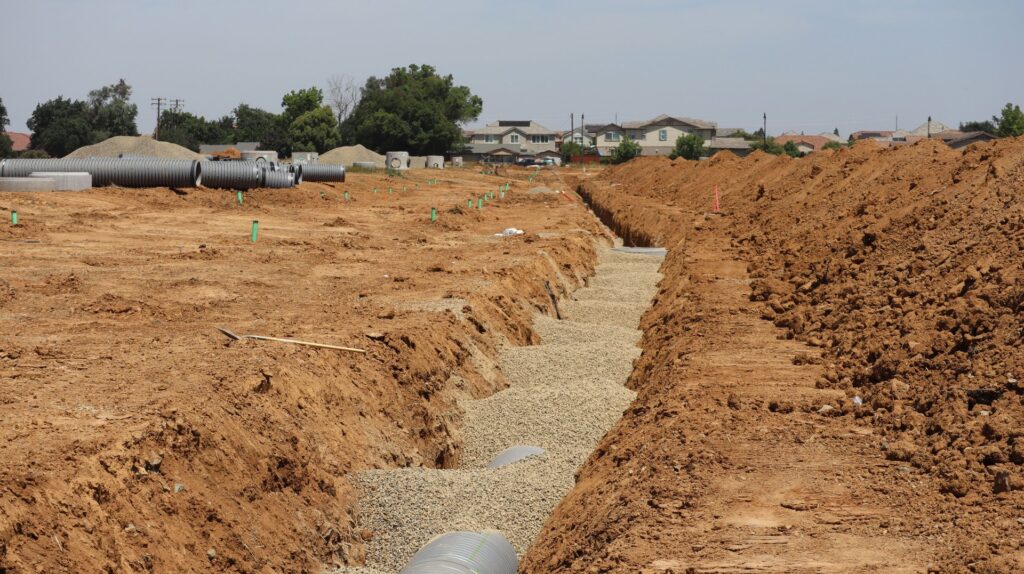
US Waterproofing's framing is the clearest available: these are not one system in two places, they are different projects. Exterior means trenching alongside the foundation or across the yard, laying perforated pipe in gravel, wrapping it in filtration fabric, and backfilling. Interior means breaking a strip of basement floor typically 6 to 12 inches wide around the perimeter, digging to the footings, laying pipe and gravel, and pouring new concrete over it. Labor is 60 to 70 percent of a project either way, and the gap between the two quotes is mostly concrete work, not markup. Interior work answers water at the cove joint, seepage through floor cracks, or hydrostatic pressure from a water table that rises sharply after heavy rain or snowmelt. Exterior work answers pooling in the yard, runoff from a neighbor's property, or a grade sending water the wrong way — landscape and grading territory.
Cost per Linear Foot in the Chicago Area
Every figure below is a published third-party range for planning, not a quote from us.
| Drain type | Cost per linear foot | Typical project total |
|---|---|---|
| Surface or curtain drain in the yard | $10–$35 (US Waterproofing, HomeGuide) | $1,000–$5,000 (US Waterproofing) |
| Yard trench drain | $30–$90 (Angi, HomeAdvisor) | $2,000–$10,000 (Angi, HomeAdvisor) |
| Exterior perimeter at the foundation | $25–$50 (US Waterproofing); $30–$90 deep weeping tile (HomeGuide) | $2,500–$8,000 (US Waterproofing) |
| Interior basement perimeter | $58–$70 Chicago (US Waterproofing); $40–$85 (HomeGuide) | $5,800–$10,500 (US Waterproofing); $4,000–$17,000 (HomeGuide) |
By length, HomeGuide's exterior numbers run $500 to $1,800 for 50 feet, $1,000 to $3,500 for 100 feet, and $2,000 to $7,000 for 200 feet. Angi and HomeAdvisor put the national average project at $9,250 inside a $400 to $27,000 span, roughly $45 per linear foot. Add-ons separate quotes: a sump pump runs $500 to $2,000.
How Long It Lasts and What Maintenance It Needs
A correctly built French drain lasts 30 to 40 years or more, a figure HomeGuide, HomeAdvisor, and US Waterproofing all publish. HomeGuide adds two qualifiers: systems with a sump pump typically need service within 10 years, and drains in sandy soil or heavy vegetation often last less.
Maintenance is light but not zero. HomeGuide recommends cleaning at least once a year and prices it at $80 to $500 or more depending on clog severity, with contractors clearing the line using an electric sewer snake. Clogs trace to three causes — incorrect installation, root intrusion, and debris buildup — the strongest practical argument for lining the trench with geotextile fabric rather than a pipe sock alone.
French Drains in Chicago: FAQ
How deep should a French drain be in the Chicago area?
HomeGuide puts a residential French drain at 12 to 24 inches deep, at least 12 inches wide, and 2 to 5 feet from the foundation. US Waterproofing says yard drainage work usually stays 1 to 2 feet below the surface, and that a French drain in its original sense sits 8 to 24 inches down. Drains at the footings go deeper and are a different project.
How much does a French drain cost per linear foot in Chicago?
US Waterproofing's Chicago figures are $10 to $35 per foot for an exterior yard or curtain drain, $25 to $50 for an exterior perimeter drain at the foundation, and $58 to $70 for an interior basement system. Angi's national range is $10 to $100 per foot with a $9,250 average project, which HomeAdvisor works out to about $45 per foot.
What is the difference between a French drain and a curtain drain?
A curtain drain is a shallower interception drain, 2 feet or more deep and soil-covered, set upslope of the wet area to cut water off before it arrives. HomeAdvisor notes it diverts mostly surface water, while a deep French drain also handles groundwater. HomeGuide prices curtain drains at $10 to $35 per foot, generally below deep perimeter systems.
Where does a French drain drain to?
HomeGuide lists four outlets: to daylight at a lower point away from the house, into a dry well, into a sump basin, or into a nearby storm drain. Some drains need no outlet when the soil accepts water fast enough along the run. Storm sewer connections often carry extra permit fees and rules vary by village, so confirm locally first.
Do French drains work in clay soil?
Yes, but the specification changes. US Waterproofing describes Chicago's dense, clay-heavy glacial soil as ground that holds water rather than draining it, which lengthens excavation and can call for different drainage specifications than a sandy-soil market. In practice: washed gravel rather than clay backfill, a properly sized outlet, and slope built in with margin.
Do I need a permit for a French drain in Illinois?
Often, and it depends on your municipality. HomeGuide says most areas require one, at $100 to $375 or more when connecting to a public storm drain; Angi puts permits at $50 to $200 and inspections at $100 to $300. The Village of Skokie lists grading and site drainage among the projects requiring a building permit. Check with your village, and call 811 before digging.
How long do French drains last, and do they need maintenance?
HomeGuide, HomeAdvisor, and US Waterproofing all put a correctly built drain at 30 to 40 years or more. Systems with a sump pump usually need pump service within 10 years. HomeGuide recommends cleaning at least annually and prices clearing a clog at $80 to $500 or more; root intrusion, debris buildup, and poor installation are the usual causes.
Have the Trench Planned Before It Is Dug
Depth, slope, fabric, and outlet are settled before the first shovel goes in, and they separate a drain still working in thirty years from one that comes back up in two springs. R & G Almanza Landscape Inc is a family-owned, insured landscape contractor working on drainage and grading across Skokie, Evanston, Chicago, and the North Shore since 1999. If water is coming up through your lawn or sitting along the foundation after every storm, call (847) 869-8584 or contact us before you commit to a trench.