Chicago yard drainage solutions generally come down to four fixes, and each one solves a different problem: a French drain moves water that is seeping underground, regrading fixes a yard that slopes the wrong way, downspout extensions stop roof runoff from dumping at the foundation, and a dry well gives water with nowhere else to go a place to soak in. The right fix depends on where the water is coming from, not just where it ends up.
Below is a decision table matched to what you are actually seeing in your yard, a closer look at each fix, what is different about this work on Chicago and North Shore clay soil, and the questions homeowners ask most about a backyard flooding fix.
Chicago Yard Drainage: Symptom, Cause, and Fix at a Glance
Use this table to narrow down which category your water problem falls into before you call anyone. Costs below are published 2026 ranges from third-party cost guides, not R & G Almanza pricing, and are meant for planning, not as a quote.
| Symptom | Likely cause | Typical fix | Attributed cost range (2026) |
|---|---|---|---|
| Water sits in a low spot for hours or days after rain | Poor grade, compacted soil, or heavy clay that will not absorb water | Regrading / lawn leveling | $500–$5,000 for a full backyard (HomeGuide); $1,022–$3,333, avg. $2,177 (Angi) |
| Water sheets toward the house and collects along the foundation | Negative grade sloping toward the home instead of away from it | Regrading around the foundation | $1,000–$3,000 around the foundation (Angi); $500–$3,000 (HomeGuide) |
| A soggy, spongy strip runs across the lawn and water seeps up steadily rather than running off | Underground seepage, a high water table, or subsurface flow through clay | French drain (trench, perforated pipe, gravel) | $10–$100 per linear foot, national avg. $9,250 (Angi); Chicago-area exterior yard drain $10–$35/ft, $1,000–$5,000 typical; exterior perimeter drain at the foundation $25–$50/ft, $2,500–$8,000 (US Waterproofing) |
| Downspouts dump water right at the foundation; mulch washes out and soil erodes near the wall | Downspouts with no extension, or an extension that is too short | Downspout extensions and pop-up emitters | $5–$20 for a basic extension (HomeGuide); $150–$350 per downspout for a full underground run with catch basin and bubbler (HomeGuide) |
| A low corner collects runoff with no municipal storm outlet or slope to drain toward | No drainage outlet for that part of the yard | Dry well (buried gravel bed or chamber) | $1,334–$5,139, avg. ~$3,110 (HomeAdvisor, Angi) |
| Water in the basement, damp foundation walls, cracks with moisture, or sewer odor | Foundation crack, failing waterproofing, or a sanitary sewer issue — not a surface drainage problem | Call a plumber or a basement waterproofing contractor | Not a landscaping cost; get a foundation/plumbing evaluation first |
French Drains: When the Water Is Moving Underground
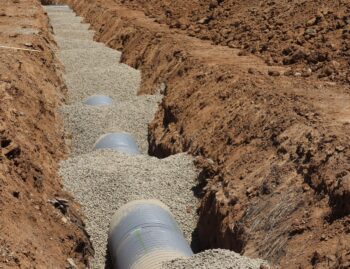
A French drain is a trench dug along the path of the water, lined with gravel around a perforated pipe, that intercepts water below the surface and carries it somewhere it can drain safely instead of seeping toward your foundation or pooling under the lawn. It is the right call when the problem is not water sitting on top of the ground but water moving through the soil, the soggy strip that never quite dries out days after the last rain.
Cost swings widely because trench length, depth, and pipe size all change the math. Angi puts French drain installation at $10 to $100 per linear foot, with a national average project cost around $9,250, while a smaller 50-foot run can land between $500 and $5,000 installed. US Waterproofing's Chicago-area guide splits that by drain type: an exterior surface or curtain drain in the yard runs $10 to $35 per linear foot ($1,000 to $5,000 for a typical project), an exterior perimeter drain at the foundation runs $25 to $50 per foot ($2,500 to $8,000), and an interior perimeter system for basement seepage runs $58 to $70 per foot in Chicago ($5,800 to $10,500). A properly built French drain lasts 30 to 40 years, which US Waterproofing works out to $167 to $308 a year over 30 years.
French drain installation Chicago projects share one wrinkle the national averages do not account for: the clay soil under most North Shore and city lots does not drain the way sandy or loamy soil does, so a trench that would be overkill in a well-drained climate is often the minimum here.
Regrading and Lawn Leveling: Fixing the Slope Itself
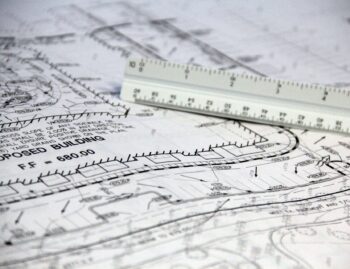
Sometimes the yard was never sloped correctly, or years of settling, foundation planting, and mulch buildup have flattened or reversed the grade near the house. When that is the case, no amount of drainage piping fixes the underlying problem, because water follows the path the ground gives it. Regrading resets that slope, typically aiming for a few inches of fall over the first several feet away from the foundation, so water moves away from the house instead of pooling against it.
HomeGuide prices a small-lawn regrade at $500 to $1,000 and a full backyard regrade at $1,000 to $5,000, with land leveling running $0.40 to $2.00 per square foot depending on how much soil has to move. Angi's numbers land in a similar band: $1,022 to $3,333 for a typical project, averaging around $2,177, or $1 to $2 per square foot. Foundation-specific grading is usually cheaper because it is a narrower strip of work: Angi puts regrading around the foundation at $1,000 to $3,000, and HomeGuide's range for fixing the grade around a house is $500 to $3,000.
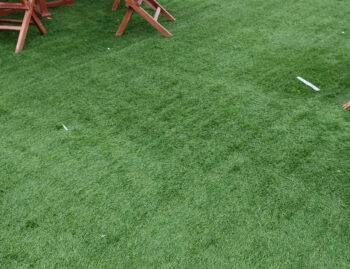
Regrading almost always disturbs the existing turf, and a freshly leveled yard with bare or thin patches rarely fills back in well on its own, especially heading into a Chicago winter. Most homeowners pair a regrade with fresh sod installation over the reworked soil so the new grade holds and the lawn comes back looking finished rather than patchy. If your low spot is really a yard-wide grading problem rather than one wet corner, our grading and drainage service is where that work starts.
Downspout Extensions and Pop-Up Emitters: The Cheapest Fix First
Before spending on a trench or a buried well, check where your roof water actually lands. A huge share of "yard flooding" is really downspout drainage aimed at the foundation from a two- or three-foot stub that dumps thousands of gallons a year in the same six-square-foot patch of ground. That is often the cheapest problem on this whole list to fix.
A basic above-ground downspout extension runs $5 to $20 per downspout according to HomeGuide, and Fixr puts extensions in a similar $2 to $17 range, with 4-inch perforated drain pipe for a longer buried run priced around $1.28 to $1.50 per linear foot. Stepping up to a full underground extension, one that routes water through buried pipe to a pop-up emitter (sometimes called a bubbler) well away from the house, runs $150 to $350 per downspout according to HomeGuide, which HomeGuide says covers an extension up to 10 feet long, trenching, a catch basin, the drainpipe, and a bubbler outlet. A pop-up emitter sits flush with the lawn and only opens under water pressure, so it does not leave a visible pipe end or a tripping hazard in the yard.
If you only fix one thing this season, this is usually the highest return for the money: inexpensive, no digging up a healthy lawn, and it removes water at the source instead of managing it after it has pooled.
Dry Wells: When the Water Has Nowhere Else to Go
A dry well is a buried chamber or gravel-filled pit that collects water, usually from a French drain, a downspout, or a low corner of the yard, and lets it percolate slowly into the surrounding soil instead of running off. It earns its place here for yards with a genuine dead end: a low spot with no slope to drain toward and no nearby storm connection.
HomeAdvisor puts dry well installation at an average of about $3,110, with most projects landing between $1,334 and $5,139, and a range that stretches from $200 for a small unit up to $10,300 for a large or complex install. Angi publishes the same figures: an average of $3,110 and a typical range of $1,334 to $5,139. Material drives a lot of that spread: gravel-only dry wells run roughly $50 to $250, plastic chamber units run $90 to $650, and poured concrete systems can climb to $4,500 or more. Budget separately for a percolation test, priced at $150 to $1,000 by Angi and $670 to $2,200 by HomeAdvisor, since that test tells you whether your soil will actually accept the water a dry well is supposed to absorb.
That percolation step matters more here than in most parts of the country. Heavy Chicago-area clay percolates slowly, so a dry well sized for sandy soil elsewhere can back up here unless it is oversized, set below the clay layer, or paired with a French drain that feeds it gradually. Hardscape matters too: a paver or concrete patio that sheds water toward the wrong corner can overload an undersized dry well, so drainage is worth planning alongside any new patio paving project rather than added after the patio is already poured.
When It Is a Sewer or Foundation Problem Instead
Not every wet yard is a yard drainage problem. If water is showing up inside the basement, if foundation walls feel damp or show cracks with active moisture, or if you smell sewage after a heavy rain, that points to a foundation, waterproofing, or sanitary sewer issue rather than surface drainage. A French drain, regrade, or dry well outside the house will not fix a cracked foundation wall or a failing sewer lateral, and in some cases surface work alone can mask a bigger problem for a season before it resurfaces.
In that situation, the right call is a plumber for sewer and sump-related issues, or a basement waterproofing contractor for foundation seepage. A simple way to sort it out: water problems entirely outside, on the lawn or near a downspout, are usually a yard drainage fix. Water getting inside the house means start with a plumber or waterproofer, not a landscaper.
Chicago and North Shore Drainage Specifics
A few things make yard drainage solutions in the Chicago area different from the national playbook. Heavy clay soil, common across Skokie and the North Shore, drains slowly and holds water near the surface far longer than sandy or loamy soil, which is why grading and French drain work here tends to need deeper trenches, more gravel, and steeper grades than a generic online guide assumes. Freeze-thaw cycles compound it: ground that stays saturated through a Chicago winter heaves as it freezes and settles unevenly as it thaws, which can undo a shallow or undersized fix within a season or two.
Sump pump discharge and any new drain line running toward the property line are also worth checking with your village before you dig. Chicago-area municipalities differ on where a sump or drain line can daylight, how far it must stay from a neighbor's property or the public right-of-way, and whether tying into the sanitary sewer is permitted (most prohibit it). MWRD (Metropolitan Water Reclamation District) rules add another layer for anything connecting to a combined or storm sewer. None of that is a reason to skip the fix, it just means a quick call to your village's public works or building department first saves a redo later.
Yard Drainage Solutions Chicago: FAQ
What is the best yard drainage solution for a Chicago backyard?
There is no single best fix, it depends on where the water is coming from. Downspout extensions handle roof runoff, regrading fixes a yard sloped the wrong way, a French drain handles underground seepage, and a dry well gives water with nowhere else to go a place to absorb. Most Chicago yards need one or two of these, not all four.
How much does French drain installation cost in Chicago?
Angi puts French drains at $10 to $100 per linear foot nationally, with a $9,250 average project cost. US Waterproofing's Chicago-area guide puts an exterior yard drain at $10 to $35 per foot ($1,000 to $5,000 for a typical project) and an exterior perimeter drain at the foundation at $25 to $50 per foot ($2,500 to $8,000). Clay soil and freeze-thaw depth often push North Shore projects toward the higher end.
Will regrading my yard fix standing water on its own?
Often, yes, if the cause is a flat or reverse-sloped yard rather than underground seepage. Regrading costs $500 to $5,000 for a full backyard, per HomeGuide and Angi. If water keeps returning after a proper regrade, the problem is usually subsurface, and a French drain or dry well is the next step.
Can I fix backyard flooding just by extending my downspouts?
Sometimes, and it is worth trying first since it is the cheapest option here. A basic extension runs $5 to $20 per downspout, or $150 to $350 for a full underground run to a pop-up emitter, per HomeGuide. If flooding continues after roof water is routed well away from the house, the grade or soil is the bigger issue.
Do dry wells work in Chicago's clay soil?
They can, but clay percolates slowly, so a dry well here usually needs to be larger or set deeper than one built for sandy soil, and a percolation test (Angi: $150 to $1,000; HomeAdvisor: $670 to $2,200) is worth confirming the soil will actually accept the water. Pairing a dry well with a French drain that feeds it gradually is common on tighter clay lots.
Do I need a permit for a French drain or dry well in Illinois?
It depends on your village. Many Chicago-area municipalities require a permit for work that involves a new discharge point, a line near the property line, or anything connecting to municipal storm infrastructure. Check with your village's building or public works department before digging, since rules vary block to block across Cook County.
How do I know if my problem is drainage or a foundation issue?
If the water stays outside on the lawn, near a downspout, or along a fence line, it is very likely a surface drainage fix. If water is getting inside the basement, walls feel damp, or you notice cracks with active moisture, that points to a foundation or waterproofing issue, and the right call is a plumber or waterproofing contractor rather than a yard drainage fix.
How long does a Chicago yard drainage fix actually last?
A properly built French drain typically lasts 30 to 40 years according to US Waterproofing. Regrading holds indefinitely as long as the slope is not disturbed by later landscaping or construction. Dry wells and downspout extensions last for decades but depend on periodic checks, since a clogged inlet or a settled pipe can quietly stop either one from working.
Get a Drainage Plan Built for Your Yard
Cost guides can tell you the range, but the right fix for your yard depends on your grade, your soil, and where the water is actually coming from, which is easiest to sort out with a look at the site itself. R & G Almanza Landscape Inc is a family-owned, insured yard drainage contractor that has worked on yard grading and drainage across Skokie, Chicago, and the North Shore since 1999. If your yard is holding water after every rain, contact us to talk through what your yard needs before you spend on the wrong fix.