The hardscape that lasts in a Chicago backyard is built for freeze-thaw and de-icing salt, not just for looks. That means dry-laid paver and stone surfaces that lift and reset instead of cracking in place, gravel and permeable areas that let water through rather than shedding it toward the house, low seating walls that define a space without the height of a retaining wall, and fire features sized to the lot. The 15 ideas below are grouped by what they do, with the material notes that decide which survive a local winter.
Chicago backyards come in two shapes, and both are covered here: the compact bungalow lot common across Skokie and Evanston, where one well-planned surface beats four small ones, and the deeper North Shore property, where the job is zoning a large yard so it does not read as one empty lawn. Our hardscaping services cover the walkways, steps, walls, fire features and stone work described here; if you want numbers first, start with what hardscaping costs in Chicago.
Hardscape Ideas That Handle a Chicago Winter
| Idea | Best for | Winter note |
|---|---|---|
| Curved paver walkway | Front and side approaches | Single pavers reset without rebuilding the run |
| Bluestone or flagstone steppers | Informal paths | Needs a gravel setting bed, not turf |
| Dry-laid stone seating wall | Patio edges, fire pit surrounds | No mortar joints for salt to attack |
| Gas fire pit | Everyday use, small lots | No wood storage, instant shutoff |
| Wood-burning fire pit | Larger yards, cooking | Fire brick interior takes the heat |
| Gravel courtyard | Side yards, seating nooks | Drains well; harder to shovel |
| Permeable paver zone | Flat lots, poor drainage | Needs a deeper base on clay |
| Steel edging | Beds, gravel, path shoulders | Holds a line through heave better than plastic |
| Raised stone planters | Small yards, poor soil | Warms and drains earlier in spring |
| Low garden wall as a divider | Zoning a long yard | Below the height where frost pressure builds |
| Path and step lighting | Every yard | Extends evenings into fall |
| Dry creek bed of stone | Low spots, downspout runs | Moves meltwater, does not hold it |
| Single-surface layout | Bungalow yards | One base, one drainage plan |
| Zoned estate layout | North Shore lots | Long stone runs need expansion planning |
| Stone landing at a side door | Service doors, alley gates | Takes the worst salt exposure |
Paths and steps
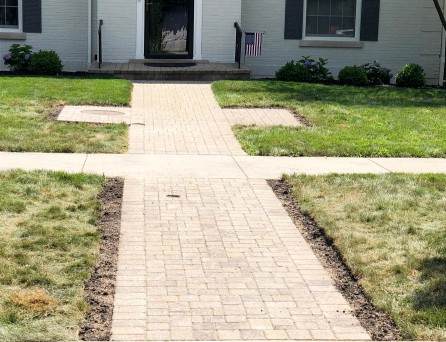
A curved paver walkway does two things a straight one cannot: it slows the walk so the yard reads as a place rather than a route, and it lets the path avoid tree roots and low spots instead of fighting them. HomeGuide notes curves and patterns like herringbone or basket weave take more labor and generate more cut waste than a straight run, so a curve is a design choice with a price attached. A contrasting border course is the simplest way to make a plain field of pavers look deliberate.
Bluestone and flagstone steppers set into gravel or lawn suit a garden path where a full walkway would be too much surface. One caution from HomeGuide: landscapers do not recommend setting patio stones directly on a lawn, because the stones sink, go uneven and attract mold and pests. Steppers need the same compacted base as any stone, in smaller footprints. Pea gravel between them — $0.85 to $2.80 per square foot installed, per HomeGuide — finishes the gaps.
A gravel courtyard is the most forgiving hard surface in a Chicago yard. It drains, it is easy to repair, and HomeGuide puts a gravel walkway at $1 to $3 per square foot against $16 to $35 for natural stone. Fixr prices a small pea gravel seating area at around $120 for 25 square feet three inches deep. The tradeoff is shoveling — HomeGuide lists snow clearing as a drawback of gravel and cobblestone alike — so it suits a spot you are not clearing every January.
A stone landing at a side door is the least glamorous idea here and often the most useful. It takes the heaviest salt and boot traffic on the property, so it is where dense, weather-resistant stone earns its price: HomeGuide calls granite the most weather-resistant walkway stone.
Walls and edges
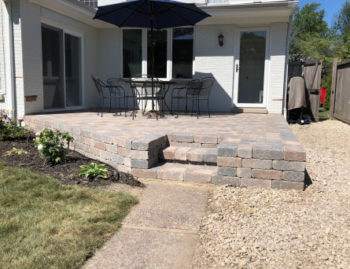
A dry-laid stone seating wall at roughly 18 to 24 inches gives a patio an edge, a fire pit a ring of seats and a yard a defined room, without the engineering of a wall holding back soil. Dry-laid is the point in this climate: HomeGuide notes dry-laid installation on gravel and sand is the most common method, while mortar-set stone costs more — and mortar joints are exactly what de-icing salt attacks first. If the wall wraps a fire pit, HomeGuide adds a code note worth checking locally: not all building codes allow wood benches near a fire pit, since wood is flammable.
Raised stone planters solve two problems at once: they lift root zones out of heavy clay that stays cold and wet into spring, and they give a small yard vertical interest without taking floor space. Built in the same stone as a seating wall or step, they tie a yard together.
Steel edging decides whether everything else still looks sharp in year five. HomeGuide is direct: you need to edge a stone walkway to stop pavers spreading apart over time, which also leads to more weeds growing between them, and puts landscape curbing at $5 to $18 per linear foot. Steel holds a line through heave better than thin plastic that lifts after a hard freeze.
Fire features
The gas versus wood decision comes down to lot size and how often you will light it. A gas pit lights and shuts off instantly and needs no wood storage — the right answer on a small Skokie or Evanston lot where smoke drifts straight into a neighbor's window. HomeGuide prices a permanent natural gas fire pit at $3,500 to $8,000 installed and propane at $900 to $2,000, against $500 to $6,000 for wood-burning depending on the finish. A wood pit earns its place on a deeper yard where smoke has somewhere to go and you want to cook over it.
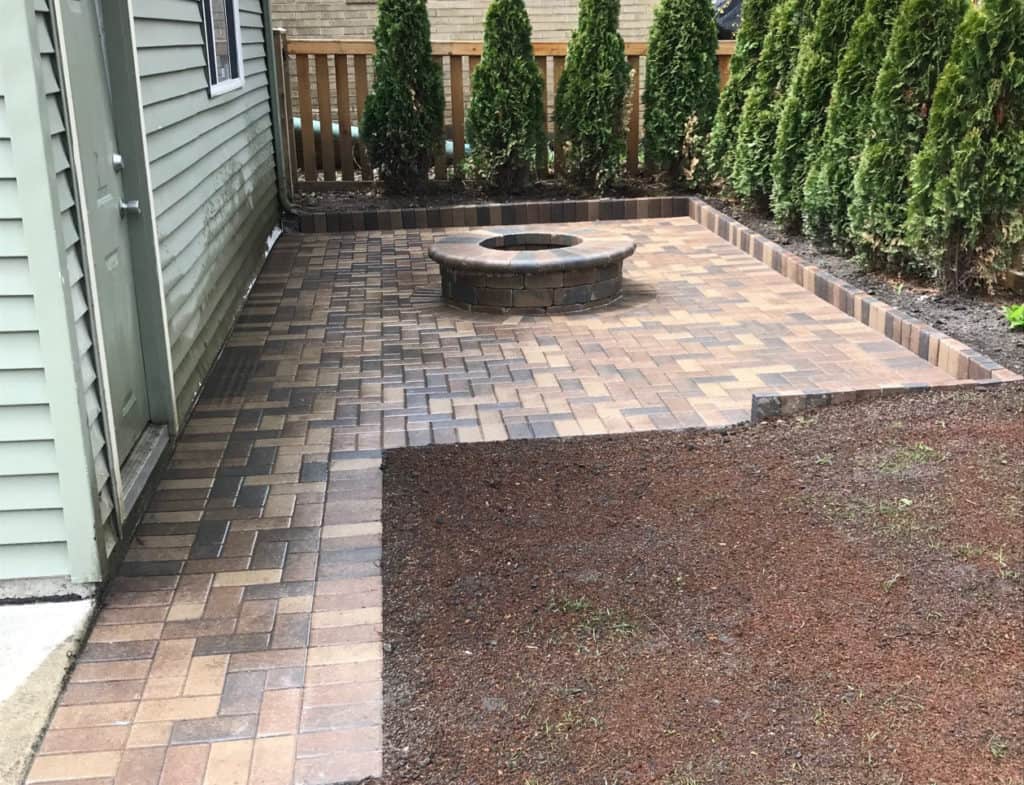
Whichever fuel you choose, two material facts matter more than style. HomeGuide says not to build a fire pit from limestone, sandstone or river rock, because those stones absorb more water and can explode when heated; fire brick at $150 to $450 per pit is the interior lining that takes the heat. And for a sunken pit, HomeGuide notes drainage is necessary to prevent flooding when it rains, pricing a French drain at $10 to $35 per linear foot. On Chicago clay, a sunken fire pit without drainage becomes a pond by April.
Water, drainage and stone
Permeable pavers are the idea most specific to this region. Every new hard surface stops rain soaking in where it lands, and on a flat lot that water has to go somewhere. HomeGuide prices permeable pavers at $10 to $30 per square foot installed, lists preventing flooding and drain problems among their advantages, and notes they reduce the need for drainage infrastructure. Two local caveats: clay soils need a deeper base, and these surfaces need cleaning — $0.25 to $0.50 per square foot — to prevent clogging.
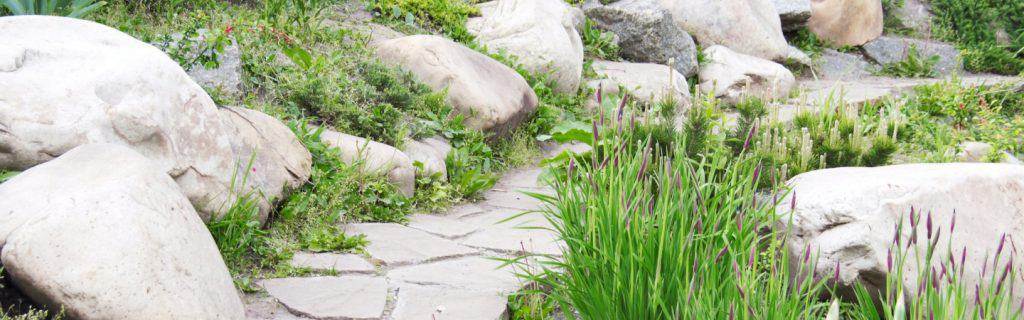
A dry creek bed of river rock does the same work with no paving at all, carrying meltwater and downspout discharge along a planned route instead of letting it pick its own. Fixr prices a whole landscaping stone project at $250 to $2,500 with a national average of $600, and notes rock lasts 15 years or more without being topped up, where wood mulch needs replenishing every one to two years — though rock does not enrich the soil the way mulch does. There is more on stone types and coverage in our guide to landscaping with rocks.
Lighting
Lighting is the smallest line item that gets more months out of everything above. A lit path and a lit step change when a yard is usable, not just how it looks — which matters in a city where useful evening light is gone by five in November. HomeGuide puts hardwired outdoor fixtures at $80 to $300 each and solar path lights at $10 to $30.
Small-Lot Layouts for Skokie and Evanston Bungalow Yards
On a standard bungalow lot, the common mistake is chopping a small yard into four features. One larger surface with a clear edge reads bigger than several competing ones, and costs less: HomeGuide notes per-square-foot prices are lowest on big projects because of company minimums.
A layout that works on a narrow lot has three moves. One continuous paved area sized to the furniture that will sit on it. One path from the back door to the garage or gate, at HomeGuide's 2.5 to 3 feet for a single-file side path rather than a full 4-foot front walkway. And one vertical element — a seating wall, raised planter or fire pit — to give the flat rectangle a focal point. Keep the palette to two materials.
North Shore Estate Scale: Zones, Sight Lines and Long Runs
Deeper North Shore properties have the opposite problem: too much undifferentiated space. The work is zoning — a paved area near the house, a destination further out, a considered route between. Width should grow with distance: HomeGuide's 5-foot comfortable width matters more on a 90-foot run than a 20-foot one.
At estate scale, three details separate good work from merely large work. Sight lines: a path that ends at something — a fire feature, a planter, a tree — not trailing off. Repetition: the same stone in landings, treads and wall caps, so the yard reads as one landscape design. And upkeep sized to the surface, since Angi suggests budgeting 5% to 10% of installation cost per year.
Materials That Survive Freeze-Thaw and Salt
Two forces decide how a Chicago backyard hardscape ages: water freezing inside the material, and the salt used to keep it walkable.
| Material | How it handles winter | Source note |
|---|---|---|
| Granite | Most weather-resistant and longest lasting | HomeGuide |
| Bluestone | 35 to 50+ years, slip-resistant, porous; cracks without sealant | HomeGuide |
| Concrete pavers | 25 to 35 years; replace units individually | HomeGuide |
| Cobblestone | 50 to 100+ years, non-slip, hard to shovel | HomeGuide |
| Sandstone | 20 to 50 years; needs the strongest sealer | HomeGuide |
| Poured concrete | 25 to 50 years, but cracks without expansion joints | HomeGuide |
Two rules follow. Dry-laid beats mortar-set masonry in this climate wherever the design allows, because a unit that lifts and resets is repairable and a cracked slab is not. And sealant is not optional on porous stone: HomeGuide flags sandstone and bluestone as prone to cracking without it, and puts paver sealing at $2 to $4 per square foot, reapplied every two to five years.
What to Avoid in a Chicago Backyard
- Rock salt on stone. HomeGuide states rock salt ruins a stone walkway: it weakens mortared joints, causes the surface to flake off and discolors stones. Use magnesium chloride, calcium chloride or potassium chloride instead.
- Stones set straight on the lawn. They sink, go uneven, and attract mold and pests, per HomeGuide. Every stone needs a base.
- A thin base on clay. HomeGuide calls for a compacted gravel base of 4 to 10 inches according to ground conditions, notes clay soils need a deeper base, and says freeze-thaw areas require deeper excavation and more robust base preparation to prevent heaving.
- Limestone, sandstone or river rock inside a fire pit. They absorb water and can explode when heated, per HomeGuide.
- Paving without deciding where the water goes. Every new square foot of hard surface no longer absorbs rain.
- Gravel on the route you shovel. Fine for a courtyard, frustrating on the path to the back door.
Backyard Hardscape Questions: FAQ
What works best in a small Chicago backyard?
One continuous paved area rather than several small ones, a single-file side path at 2.5 to 3 feet (HomeGuide's width for a secondary walkway), and one vertical feature — a seating wall, raised planter or compact fire pit — as a focal point. Two materials rather than four makes a small yard read larger, and one bigger surface costs less per square foot.
Gas or wood fire pit for a Chicago backyard?
Gas suits tight lots: instant on and off, no wood storage, no smoke drifting next door. HomeGuide prices a permanent natural gas pit at $3,500 to $8,000 installed and propane at $900 to $2,000, against $500 to $6,000 for wood-burning. Wood makes more sense on a deeper yard where smoke has room and you want to cook over the fire.
Do pavers survive Chicago freeze-thaw?
Yes, when the base is built for it. HomeGuide notes freeze-thaw areas require deeper excavation and more robust base preparation to prevent heaving, and that clay soils need a deeper base. The advantage of unit paving is repairability — a heaved paver lifts and resets, where a cracked slab is replaced in sections.
What is the difference between hardscape and softscape?
Hardscape is the built, non-living part of a yard: paving, walls, steps, edging, gravel, fire features. Softscape is everything living — lawn, beds, shrubs, trees. A plan needs both, and hardscape goes in first because it sets the grade, the drainage and the geometry the planting works around.
Will de-icing salt damage a stone patio or walkway?
Rock salt does damage stone. HomeGuide states it weakens mortared joints, causes the surface to flake off and discolors stones, and recommends magnesium chloride, calcium chloride or potassium chloride instead. Dry-laid surfaces with sand joints hold up better than mortared ones, which is why dry-laid construction suits this climate.
How do permeable pavers help a Chicago backyard?
They let rain pass through instead of shedding it to a low spot. HomeGuide lists preventing flooding and drain problems among their advantages and notes they reduce the need for drainage infrastructure, at $10 to $30 per square foot installed. They need a deeper base on clay and cleaning at $0.25 to $0.50 per square foot to stay permeable.
What hardscape works on a North Shore estate lot?
Zoning rather than one big surface: a paved area near the house, a destination further out, a considered route between. Wider walkways carry longer runs — HomeGuide's 5-foot comfortable width matters more over 90 feet than 20. Repeating one stone across landings, treads and wall caps keeps a large yard reading as one design, not a collection of projects.
Design Your Chicago Backyard Hardscape
These ideas work because they respect what this ground and climate do to stone: clay that holds water, winters that lift anything on a thin base, salt that eats mortar. Which belongs in your yard depends on the lot, the grade, the light and how you use the space. R & G Almanza Landscape Inc is a family-owned, insured crew working on walkways, steps, walls, stone and fire features across Skokie, Evanston and the greater Chicago area since 1999.
Contact us to talk through a plan for your backyard, or call R & G Almanza Landscape at (847) 869-8584.