Sunken pavers are almost always a base problem, not a paver problem. The aggregate under that spot washed out, was never compacted properly, or moved through a freeze-thaw cycle, and the pavers followed it down. The repair is to lift the sunken area plus a border of sound pavers around it, rebuild and compact the base in layers, re-screed about an inch of bedding sand, reset the same pavers and refill the joints. Angi puts patio repair at $902 to $2,911 for most projects, averaging $1,868, and prices paver repair at $7 to $30 per square foot.
That distinction matters: reset only the pavers that look wrong and the dip comes back. Below is what causes settlement in Skokie, Evanston and Chicago-area yards, what a re-level involves, the published repair ranges, and when the honest answer from patio installers is to rebuild rather than patch. If you want the underlying build sequence first, how a paver patio is built covers the base, slope and joint specifications a repair has to restore.
Why Pavers Sink and Heave in Chicago

Base washout
Water moving under a patio carries fine material with it. Over several seasons that hollows a pocket in the aggregate and the pavers above it drop. Angi's repair guide describes the tell: lift the pavers and the bedding sand under the dip is washed out, thinned or packed unevenly, with the gravel beneath eroded or shifted. Washout is usually a symptom of water arriving faster than the surface can shed it.
A base that was never properly compacted
Aggregate has to be compacted in layers to reach density. ICPI/CMHA Tech Spec 2 calls for compacting the base in 4- to 6-inch lifts and asks for at least 98 percent of standard Proctor density under pedestrian areas. A base dumped to full depth and tamped once looks identical on day one and settles unevenly for years. Angi lists this among the common mistakes: pouring the gravel in all at once or tamping too lightly.
Downspouts and the grade around the patio
A downspout discharging at the edge of a patio concentrates roof water into one spot, the fastest way to wash out a base. So does a lawn or bed that slopes toward the patio. Tech Spec 2 puts the minimum surface slope for the paving at 1.5 percent, but that only works if the water has somewhere to go once it leaves the surface.
Tree roots
Roots grow toward moisture and air, and the gravel base under a patio offers both. As a root thickens it lifts a localized area, which is why root heave looks like a ridge or a tilted cluster rather than a dip. Repairing the surface without addressing the root only resets the clock.
Freeze-thaw and frost heave
Water held in soil expands as it freezes and lifts whatever sits above it, and Skokie, Evanston and the rest of the North Shore cycle through that repeatedly each winter. The standards treat cold climates differently for that reason: Tech Spec 2 says greater base thicknesses are often used in regions with numerous freeze-thaw cycles, expansive soils or very cold climates, and Unilock's chart calls for 10 inches of gravel under a patio on clay against 6 inches on sand. A patio built to the thinner number is the one that moves here.
How Re-Leveling Actually Works
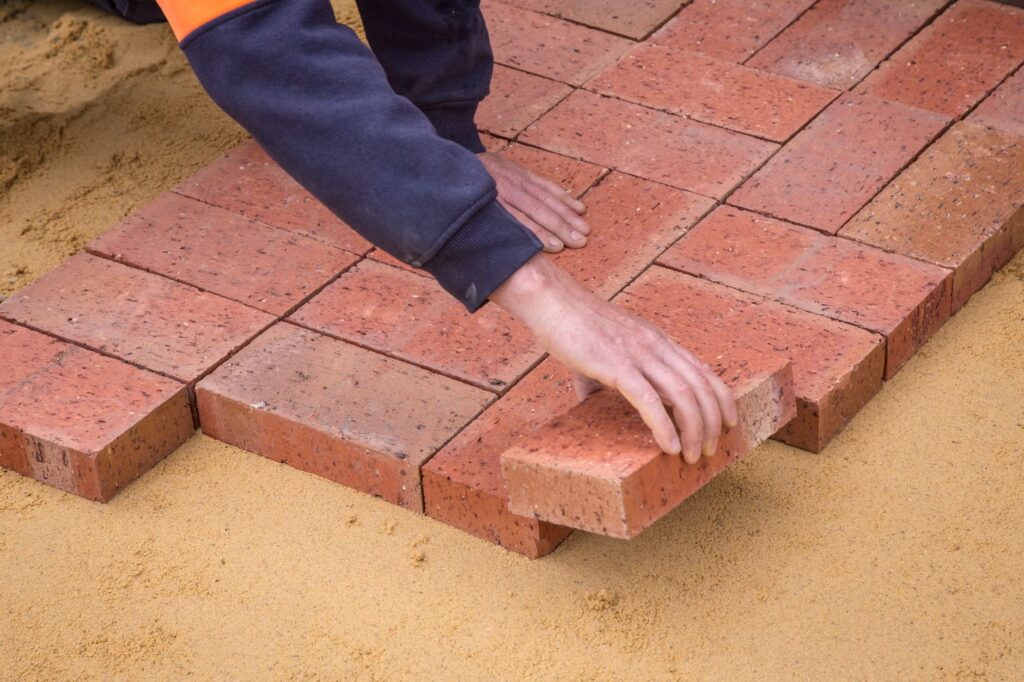
Angi's published method for resetting sunken pavers is the sequence a crew follows, at larger scale:
- Mark a working area larger than the problem. Angi says to start at the outermost edge of the sunken paver and mark at least 12 to 16 inches out in all four directions, because the base fault extends past the paver that shows it.
- Lift every paver inside the marked area, not only the low ones. Angi is explicit that pavers which still look level sit on the same compromised base, and calls removing only the visibly sunken paver the most common mistake in this repair.
- Remove all of the old bedding sand and inspect the base for soft spots, moisture or thin areas, digging out gravel that has eroded until you reach solid, compacted material. Angi cautions against reusing old bedding sand, which is usually uneven or already compressed.
- Rebuild the base in layers. Angi calls for adding gravel about 2 inches at a time and compacting each layer with a hand tamper until the base is back to its original depth, usually around 4 to 6 inches.
- Screed about 1 inch of fresh bedding sand and level it with a straight board. Angi notes the sand is not compacted, because it stays loose enough for the pavers to seat into it.
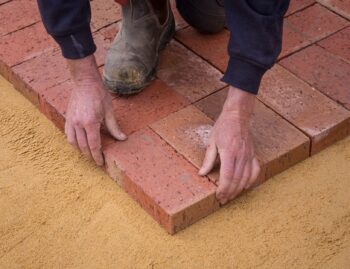
- Reset the pavers in the original pattern, placing rather than sliding them, then tapping each flush with a rubber mallet and adjusting the sand under anything high or low.
- Refill the joints, sweeping jointing sand diagonally and going over the area several times until every joint is full to the top.
Two details separate a repair that holds from one that does not: how much area gets lifted, and whether the base is rebuilt in compacted layers.
Re-Sanding the Joints
Joint sand is consumable. It erodes out through rain, snowmelt, wind and pressure washing, and once joints are low the pavers lose the interlock that stops them rocking. Re-sanding is the least expensive repair here and the one that prevents the costly ones.
If the joints are being refilled with polymeric sand, the product sets conditions. Techniseal's technical data sheet for EZSAND requires joints empty to a minimum depth of 1.5 inches before new sand goes in, so old material comes out rather than being topped up. It calls for joint widths between 1/16 and 1/2 inch, describes mechanical compaction as mandatory, requires the surface and joints completely dry, and requires temperatures above 32 degrees Fahrenheit for the 48 hours that follow. It also says the product must set at least 90 minutes before unexpected rain, that 24 hours without rain is the target, that sprinklers stay off 24 hours, and that no more than 200 square feet is wetted at a time.
On timing, Angi notes that with regular jointing sand you can usually walk on the area right away, while polymeric sand needs at least 24 hours before foot traffic and 48 to 72 hours before driving. Techniseal's downtime figures for EZSAND are no wait for pedestrians, 24 to 48 hours for vehicles, and 30 days before cleaning or sealing.
Replacing Broken Pavers, Efflorescence and Stains
A cracked, chipped or stained paver is the easiest defect to fix: the unit lifts out and a replacement drops into the same bedding course. Keep spares from the original pallet, since color runs change between batches.
A white haze is a different problem, and usually not a defect. The ICPI consumer guide on efflorescence explains it: calcium oxide inside the paver reacts with water in the unit's microscopic capillaries to form calcium hydroxide, which rises to the surface, meets carbon dioxide in the air and leaves a white haze of calcium carbonate. It disappears when the pavers are wet and returns as they dry. The guide says efflorescence typically stops developing in approximately 18 to 24 months and weathers away on its own, and can be removed sooner with cleaners made for concrete pavers, most of which contain acid, so test a small hidden area first. Tech Spec 2 adds that efflorescence does not affect structural performance, though it may be unsightly and difficult to remove. If you plan to seal, the ICPI guide requires pavers completely dry and free from efflorescence first.
Weeds and Ants in the Joints
Weeds in a paver surface grow in the joints, not up through the pavers, so joint condition decides the outcome. Techniseal lists weed growth inhibition and deterrence of ants and other insects among the properties of its polymeric jointing sand, along with resistance to joint erosion from water, frost heaving, wind and power washing. Full, cured joints leave little for a seed to germinate in or an ant colony to excavate, and weeds returning in the same joints usually mean joints that are low or never cured properly. Techniseal also warns that soil and organic matter left on joints, including grass clippings, plus moisture and shade, contribute to moss and premature joint deterioration.
When to Rebuild Instead of Repair
There is a published threshold. Angi's guidance is that if repair cost exceeds 50 percent of replacement cost, full replacement is the better value over time, and that replacement tends to win when the work involves lifting and resurfacing rather than isolated fixes. Angi puts full patio replacement at an average of $4,000 and as much as $14,000.
The practical signals point the same way. When settlement appears in several separate areas, when the same spot has been reset before and moved again, when the perimeter has spread because there is no working edge restraint, or when the base was built too thin for clay, the money is better spent rebuilding once. CMHA's application guide is direct that edge restraints are essential to an interlocking pavement's performance, so a patio whose perimeter has failed is rarely a candidate for spot repair. For what a full rebuild costs by material and size, our paver patio cost guide has the published ranges.
What Patio Repair Costs
Angi's 2026 patio repair data puts most projects between $902 and $2,911, averaging $1,868, with a full range from $375 to $6,600. Cost tracks material and repair type:
| Patio material | Repair cost per square foot | Source |
|---|---|---|
| Paver | $7 to $30 | Angi |
| Brick | $11 to $14 | Angi |
| Natural stone | $14 to $17 | Angi |
| Concrete | $5 to $20 | Angi |
| Stamped concrete | $6 to $20 | Angi |
Paver repair sits at the top of that spread because, as Angi notes, it often requires all new materials. Size is the other lever:
| Damaged area | Average repair cost | Cost range | Source |
|---|---|---|---|
| 10 sq ft | $100 | $80 to $300 | Angi |
| 20 sq ft | $200 | $80 to $600 | Angi |
| 50 sq ft | $500 | $200 to $1,500 | Angi |
| 100 sq ft | $1,000 | $400 to $3,000 | Angi |
| 200 sq ft | $2,000 | $800 to $6,000 | Angi |
Angi's guide to sunken pavers gives a second reference point: professional hardscaping at $5 to $25 per square foot, or $500 to $2,500 for a 100-square-foot area, against $100 to $300 in materials for a homeowner doing a small section. Labor is most of the bill either way, 50 to 90 percent of patio repair costs in Angi's data at $35 to $110 per hour. These are national planning ranges, not a quote for a Chicago or North Shore yard.
A Maintenance Schedule That Prevents Most Repairs
Nearly every repair above starts small. A short seasonal routine catches it while it is joint sand and not base work:
- Every spring, walk the patio. Angi recommends checking after a wet winter or freeze-thaw cycles, and treats pooling water, loose bricks and uneven surfaces as signs the base needs attention.
- Check the joints. Low joints are the early warning. Refill before pavers start to rock, remembering Techniseal's requirement that joints be empty to 1.5 inches before new polymeric sand goes in.
- Watch where roof water lands. A shifted downspout, or an extension moved and never put back, is a base washout in progress.
- Sweep off soil and grass clippings, which Techniseal identifies as contributors to moss and premature joint deterioration.
- Schedule work for dry, mild weather. Angi advises repairing sunken pavers in dry mild conditions, ideally spring or early fall, avoiding heavy rain, freezing temperatures and extreme heat.
Paver Patio Repair FAQ
Why is my paver patio sinking?
Almost always because of what is under it. The base washed out, was never compacted in layers to the density the standards call for, or moved through freeze-thaw. Concentrated downspout water, a grade running toward the patio, and tree roots are the usual accelerators. The pavers themselves are rarely the cause, which is why resetting them alone does not hold.
Can sunken pavers be fixed without rebuilding the whole patio?
Usually yes, if the settlement is localized. Angi's method is to mark at least 12 to 16 inches out in all four directions from the sunken paver, lift everything inside, rebuild the base in roughly 2-inch compacted layers back to its original 4 to 6 inches, screed about 1 inch of fresh bedding sand, and reset the same pavers.
How much does patio repair cost?
Angi puts patio repair between $902 and $2,911 for most projects, averaging $1,868, with a full range of $375 to $6,600, and prices paver repair at $7 to $30 per square foot. For sunken pavers, Angi lists professional hardscaping at $5 to $25 per square foot, or roughly $500 to $2,500 for 100 square feet.
How often should paver joints be re-sanded?
There is no fixed interval; it depends on exposure, drainage and how the surface is cleaned. Inspect each spring and refill when joints are visibly low or pavers begin to rock. With polymeric sand, Techniseal requires joints emptied to a minimum depth of 1.5 inches first, so it is a replacement rather than a top-up.
What is the white haze on my pavers?
Efflorescence. The ICPI consumer guide describes calcium oxide in the paver reacting with water to form calcium hydroxide, which surfaces, meets carbon dioxide in the air and leaves calcium carbonate. It vanishes when pavers are wet, returns as they dry, typically stops developing in approximately 18 to 24 months, and can be removed sooner with cleaners made for concrete pavers.
When is repair no longer worth it?
Angi's threshold is that when repair cost exceeds 50 percent of replacement cost, replacement is the better value over time, and it puts full patio replacement at an average of $4,000 and up to $14,000. Repeated settlement, a failed perimeter with no working edge restraint, or a base built too thin for clay all point toward rebuilding once.
When is the right time of year to repair a patio in Chicago?
Angi recommends dry, mild weather, ideally spring or early fall, and advises against heavy rain, freezing temperatures or extreme heat. Polymeric sand sets the harder limit: Techniseal requires temperatures above 32 degrees Fahrenheit for 48 hours after installation and dry joints going in, which rules out repairs once the weather turns.
Get a Sunken Patio Looked At Before the Next Freeze
A dipped section that takes on water in October is a bigger job in April, because every freeze-thaw cycle works the gap it has already opened. R & G Almanza Landscape Inc is a family-owned, insured crew based in Skokie, working on patios, walkways and hardscape across Skokie, Evanston, the North Shore and the greater Chicago area since 1999. Contact us to request an estimate and we will look at the settlement, the drainage feeding it, and whether the base is worth resetting or rebuilding.
Call R & G Almanza Landscape at (847) 869-8584 about a sunken or shifting patio.