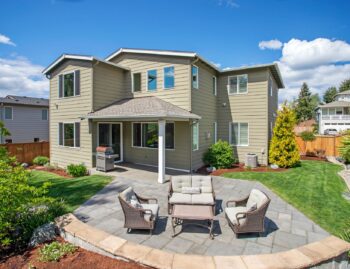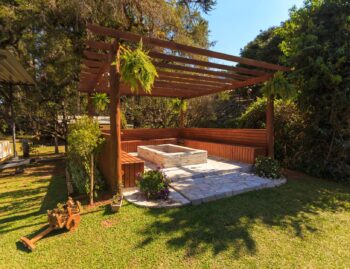
A pergola has an open slatted roof and gives partial shade, at $10 to $65 per square foot installed. A gazebo has a solid roof, built-in flooring and usually a round, oval, octagonal or hexagonal shape, at $30 to $100 per square foot. A pavilion is rectangular with open sides and a solid roof, at $35 to $60 per square foot, and HomeGuide notes it is typically larger than a gazebo. In a Chicago backyard the deciding factor is usually that roof, because a solid roof has to carry snow: the Chicago Building Code sets a ground snow load of 25 pounds per square foot, and Skokie requires a gazebo roof to be designed for a minimum of 30.
Those three sentences settle most of the decision, but not the interesting part. Shade, rain, snow, wind, footprint, maintenance and permitting pull in different directions, and the structure that is right over a paver patio is often wrong in the middle of an open lawn. Below is a straight comparison on each axis, with 2026 cost tiers and the Chicago code figures national comparison pages leave out. If you already know an open-roof structure is what you want, our page for custom pergola builders covers design and materials in more depth.
The Three Structures, Defined
Pergola. Skokie's own guidelines define it as "a structure usually consisting of parallel colonnades supporting an open roof of girders and crossrafters." HomeGuide describes the same thing as an open lattice roof for partial shade: square or rectangular, not enclosed, requiring a solid base, freestanding or lean-to. Louvered versions have slats that open and close to adjust shade.
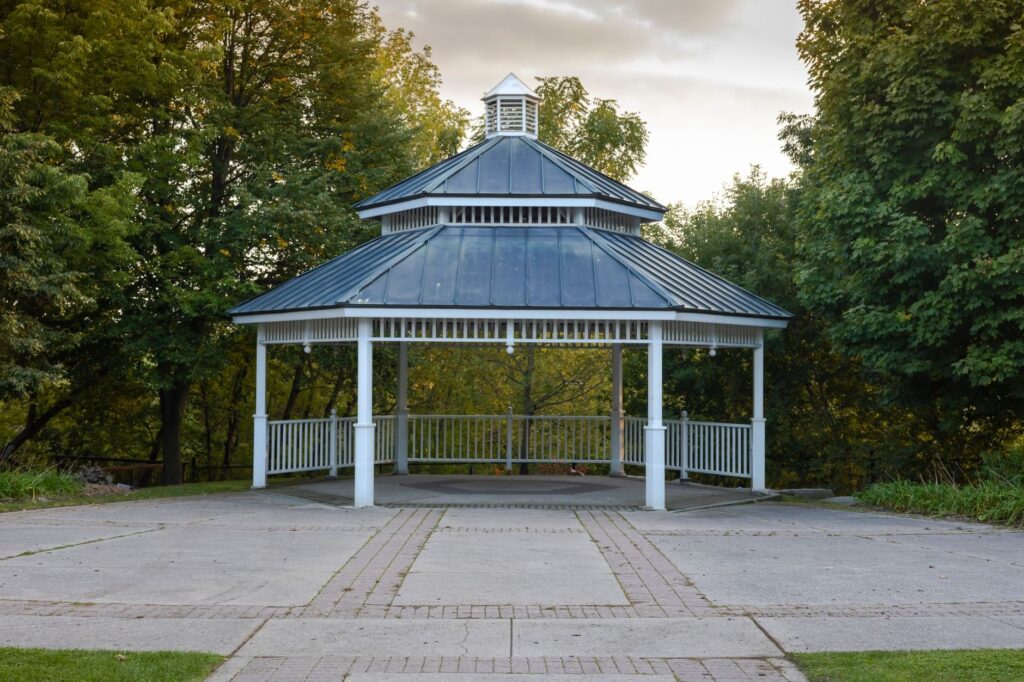
Gazebo. Skokie defines it as "a freestanding roofed structure usually open on the sides." HomeGuide adds the detail that matters: a solid roof in stronger materials, a round, oval, octagonal or hexagonal shape, railing or enclosure options, and a base and flooring that come attached. Angi describes the classic form as a polygon with six or eight sides and a pointed shingled roof.
Pavilion. Rectangular or square, open sides, a solid roof giving full shade, freestanding, and requiring concrete posts or a patio base. HomeGuide's summary is that a pavilion is typically larger than a gazebo and has no built-in floor or railings. Fixr arrives at the same structure from the other direction: adding a gabled or hipped roof to an open-sided structure means it is "no longer a true pergola but now a pavilion or an open-sided roofed structure."
That last point is the one homeowners trip over. A "pergola with a roof" is not a pergola in any catalogue, cost guide or permit office. Once a solid roof goes on, the price, the footings and the review all change.
Side by Side: Roof, Shade, Floor and Price
| Pergola | Gazebo | Pavilion | |
|---|---|---|---|
| Roof | Open slats or louvers | Solid, often shingled | Solid, tent-shaped or A-frame |
| Shade | Partial | Full | Full |
| Shape | Square or rectangular | Round, oval, octagonal, hexagonal | Rectangular or square |
| Floor | None — sits on your surface | Built-in flooring and attached base | None — concrete posts or patio base |
| Sides | Open; screens optional | Railings, seating, screening possible | Open |
| Attachment | Freestanding or lean-to | Freestanding only | Freestanding |
| Cost per sq ft installed | $10–$65 | $30–$100 | $35–$60 |
Sources: HomeGuide's pergola, gazebo and pavilion cost guides, cross-checked against Angi's comparison and Skokie's published definitions.
Shade and Rain: What Each One Actually Protects You From
On shade, HomeGuide's framing is that pergolas let more sun through the latticed roof while a gazebo gives full shade under a solid roof. Fixr is more specific about the open-top style, describing the slats as offering partial shade between 75% and 90% depending on their size and placement. You can push a pergola toward full shade with a louvered roof, a fabric canopy or climbing vines; Fixr notes a wrought-iron pergola casts almost no shade on its own because the members are so thin.
On rain, the answer is blunter. A pergola does not keep rain off. A gazebo or pavilion does, which is what makes them usable in bad weather; Angi's comparison scores durability and bad-weather usability to the gazebo for that reason. If the point is dining outdoors in a Chicago spring, that single line decides it.
Snow Load, Wind and Chicago Winters
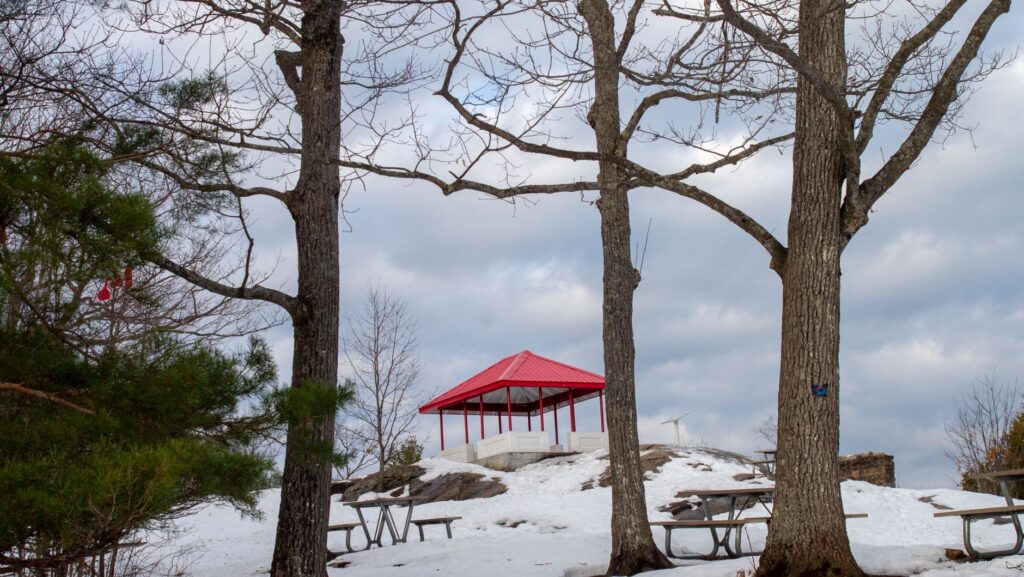
This is where national comparison pages stop being useful. A solid roof is not a shade upgrade here, it is a structural commitment.
The Chicago Building Code sets the ground snow load used for roof design at 25 pounds per square foot. The Village of Skokie goes further for this exact category of structure, requiring that "a gazebo roof snow load must be a minimum 30 pounds per square foot." Skokie also requires that "a gazebo must be supported on frost depth piers" — a requirement its sheet states for gazebos, not for pergolas. An open-rafter pergola sheds snow between its slats and never accumulates a load the way a solid roof does, which is a large part of why pergolas cost less to build and to found here.
Wind is the other half. The Chicago Building Code sets the basic design wind speed for Risk Category I structures at 101 mph. That matters most for the lightest options: an open frame with a fabric canopy stretched across it becomes a sail, and anything bolted to a sand-set surface rather than to piers has nothing to resist uplift.
Frost is the third. The Chicago Building Code protects foundations and permanent supports from frost, the first listed method being extending at least 42 inches below final grade, with an exemption for free-standing Risk Category I structures at 600 square feet or less for light-frame construction and an eave height of 10 feet or less. A big pavilion is likelier to fall outside that exemption than a small pergola.
Footprint: Matching the Structure to the Yard
Gazebos are sold in a tight band of sizes, commonly 8x8 up to 20x20 in HomeGuide's tables, and the polygon shape makes a gazebo a destination — a separate room out in the yard. Pavilions run larger, with HomeGuide pricing a 20x30 at $21,000 to $36,000, and the rectangular open-sided form covers a dining table better than it works as a focal point. Pergolas are the most flexible: HomeGuide's size table runs 8x8 to 30x30, and because a pergola has no floor, it drops onto a surface that already exists instead of claiming new ground.
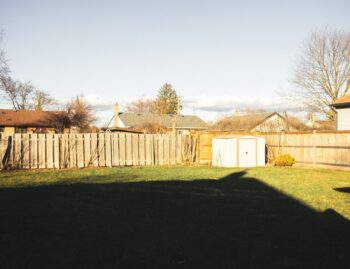
On a typical Skokie, Evanston or Wilmette lot, that difference tends to decide it. Yards here are often deeper than they are wide, with an existing patio against the house and a mature tree or two. A pergola over that patio adds shade without giving up lawn; a gazebo in the middle of the lawn takes a bite out of the only open space.
Cost Tiers
| Structure | Per sq ft installed | Typical 12' x 12' project | Source |
|---|---|---|---|
| Pergola, kit installed | $10–$40 | $1,450–$5,750 | HomeGuide |
| Pergola, custom built | $30–$65 | $4,300–$9,350 | HomeGuide |
| Gazebo, pre-cut kit installed | $30–$70 | $4,300–$10,000 | HomeGuide |
| Gazebo, custom built | $60–$100 | $8,600–$14,400 | HomeGuide |
| Pavilion | $35–$60 | $5,000–$8,600 | HomeGuide |
The gap holds across sources. Fixr puts a pergola at $1,900 to $6,500 against a gazebo at $7,500 to $10,000, and prices pavilions — which it calls pergolas with a roof — from around $5,700 to $12,000, as high as $20,000. Angi's comparison is narrower but points the same way, $2,200 to $6,400 versus $2,700 to $10,000, and scores price to the pergola on lighter material and labor. For what drives the number on a local project, see our guide to pergola cost in Chicago.
Two line items shift the comparison more than the headline rate does. Roofing is one: HomeGuide prices a pavilion roof at $3 to $6 per square foot, with metal at $5 to $16, while a louvered pergola roof runs $45 to $125. Foundation is the other: concrete pier footings at $125 to $300 each, at least four needed, and deeper footings in cold climates.
Maintenance by Material
| Material | Upkeep in this climate | Published figure | Source |
|---|---|---|---|
| Cedar | Naturally moisture- and insect-resistant; can crack; takes stain and paint well | $25–$40 per sq ft material | Fixr, HomeGuide |
| Redwood | Insect- and rot-resistant, harder than cedar so it lasts longer; needs primer before paint | $40–$50 per sq ft material | Fixr, HomeGuide |
| Pressure-treated lumber | Rot resistant but not water resistant, so it still moves and cracks without a repellent finish | Around $10–$11 per sq ft | Fixr, UMass BCT |
| Aluminum | Weather-resistant and low-maintenance; powder coated | $10–$30 per sq ft | Angi, HomeGuide |
| Vinyl | Fade-resistant, but Fixr notes it can crack in extreme cold and suits moderate climates | $10–$30 per sq ft | Angi, Fixr |
| Shingled solid roof | A roof has a replacement cycle a pergola does not | Asphalt shingle $3–$5 per sq ft | HomeGuide |
One point applies to every wood option. Building and Construction Technology at UMass Amherst notes that only the heartwood of certain species is naturally decay resistant, that untreated sapwood of virtually all species has very little, and that pressure treating makes wood rot resistant without making it water resistant. Their remedy: a water-repellent coat before installation, corrosion-resistant fasteners, brush treatment on cuts, annual retreatment. A gazebo has more wood surface to maintain than a pergola, and a pavilion adds a roof on top.
Permits Are Not the Same for All Three
Skokie's guideline sheet covers pergolas and gazebos together but applies several requirements to gazebos alone: frost depth piers, the 30-pound snow load minimum, and a GFCI receptacle within the perimeter. Zoning limits apply to both: a maximum height of 15 feet for pitched roof structures and 10 feet for flat roof structures, posts at least 3 feet from any property line in a backyard, overhangs at least 2 feet, and neither allowed in a required front or side yard. A gazebo's pointed roof is likelier to approach that 15-foot ceiling than a pergola's flat top.
HomeGuide's guidance on both gazebos and pavilions is that a permit is needed in most places, and to check with the local building department and the homeowners association. The full picture for this market, including Chicago and Evanston, is in our guide to permit rules in Chicago, Skokie and Evanston.
Which One Suits a Patio, an Outdoor Kitchen or a Fire Pit
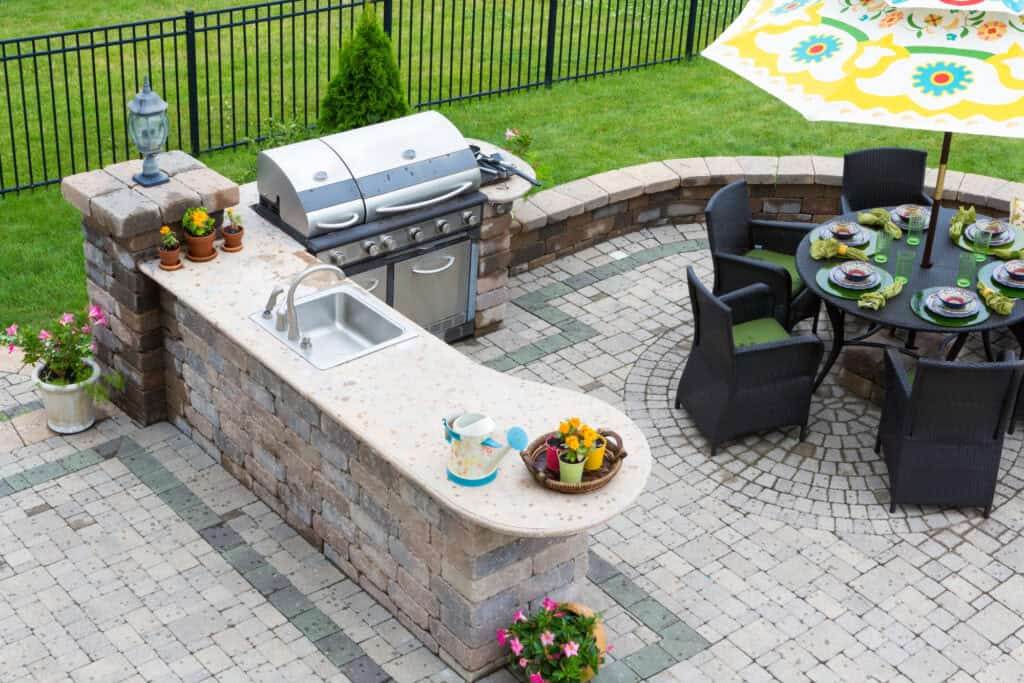
Over an existing patio: pergola. It has no floor of its own, can be freestanding or attached to the house, and HomeGuide notes attached versions use fewer columns, keeping the patio usable.
Over an outdoor kitchen or dining table: pavilion, if you want to cook and eat out there in the rain. Pergola, if the goal is taking the edge off afternoon sun without closing in the space.
With a fire pit: read the rules first. Angi lists fire-pit compatibility as a pergola advantage and a gazebo drawback. HomeGuide is more specific: most fire pits should not be under a covered patio, and one under a gazebo needs a roof at least 8 feet tall, a raised vent in the centre to release smoke, non-flammable ground, and no walls or curtains enclosing the structure.
As a garden focal point: gazebo. The polygon shape, railings and built-in seating are the point, and Angi scores durability and length of life to the gazebo.
Shade Structure FAQ
What is the difference between a pergola and a gazebo?
The roof. HomeGuide puts it directly: the biggest difference is that only a gazebo has a solid roof. A gazebo is freestanding with full shade and has railings, benches and flooring, while a pergola has an open-beam roof, no floor of its own, and gives partial shade over a patio. Skokie's definitions draw the same line between an open roof of girders and crossrafters and a roofed structure open on the sides.
What is a pavilion, and how is it different from a gazebo?
A pavilion is rectangular or square with open sides and a solid roof, and HomeGuide notes it is typically larger than a gazebo with no built-in floor or railings. A gazebo is usually round, oval, octagonal or hexagonal, comes with an attached base and flooring, and often has railings or built-in seating. Both give full shade; the pavilion covers more ground per dollar at $35 to $60 per square foot.
Which is cheaper, a pergola or a gazebo?
A pergola, at every source. HomeGuide puts pergolas at $10 to $65 per square foot installed against $30 to $100 for a gazebo. Fixr's comparison is $1,900 to $6,500 versus $7,500 to $10,000. Angi's is $2,200 to $6,400 versus $2,700 to $10,000, and it scores price to the pergola on lighter material and labor.
Does a pergola keep rain off?
No. A standard pergola has an open slatted roof, so rain passes through. Fixr describes open-top slats as giving partial shade between 75% and 90% depending on their size and placement, which is a sun figure, not a rain one. A retractable canopy or a louvered roof that closes will shed rain; an open-rafter pergola will not. If rain protection is the goal, the structure you want is a pavilion or a gazebo.
Which shade structure handles Chicago snow best?
An open-rafter pergola avoids the problem, because snow falls through the slats instead of loading a roof. Where a solid roof is wanted, it has to be designed for the load: the Chicago Building Code sets a ground snow load of 25 pounds per square foot, and Skokie requires a gazebo roof to be designed for a minimum of 30 pounds per square foot and to sit on frost depth piers.
Can you put a fire pit or grill under a gazebo?
Sometimes, with conditions. HomeGuide notes most fire pits should not be under a covered patio, and sets out what a gazebo needs: a roof at least 8 feet tall, a raised vent in the centre to release smoke, ground that is not a flammable wood surface, and no walls or curtains enclosing it. Angi lists open-air fire features as a pergola strength and a gazebo weakness.
Which structure is best over an existing patio?
A pergola, in most cases. It has no floor of its own, so it uses the surface you already have, and HomeGuide describes pergolas as requiring a solid base rather than bringing one. Attached versions use fewer columns, keeping more of the patio open. A gazebo brings its own base and flooring, duplicating a patio you have already paid for.
Deciding Between Them for Your Yard?
The comparison narrows fast once someone stands in the yard: where the sun lands at 4 p.m., how much lawn you will give up, whether you want to eat outside in the rain, and what your village allows at that spot on the plat. R & G Almanza Landscape Inc is a family-owned, insured crew building patios, hardscapes and outdoor structures across Skokie, Evanston, the North Shore and the greater Chicago area since 1999. Contact us to walk the site and talk through which structure fits.
Call R & G Almanza Landscape at (847) 869-8584 to get started.