Pergola installation in the Chicago area runs about $2,118 to $6,433 nationally, around $4,253 for a 100-square-foot structure, per Angi's 2026 data. Angi's Chicago-area figure sits higher: a normal range of $2,900 to $8,858 and an average of $5,704. What decides whether the structure is still square after ten winters is not the wood you can see, it is what sits under the posts. The Chicago Building Code requires foundations and permanent supports to be protected from frost, and the first method it lists is extending at least 42 inches below final grade.
That number changes the whole job. A 42-inch pier is a real excavation, not a stake in the lawn, and it is the difference between a structure that stays plumb and one that racks after a few freeze-thaw cycles. Below is what a Chicago build involves: site prep, footing options, anchoring to a paver patio versus a concrete slab versus open grass, attached versus freestanding framing, materials that survive North Shore winters, published 2026 cost ranges and a realistic schedule. A pergola contractor working in Skokie and Evanston is solving for frost, clay soil and snow load before anyone picks a wood species.
What Pergola Installation Involves, Start to Finish
Kit or custom build, the sequence is the same. The difference is where the labor goes: kit pieces arrive cut and often pre-drilled, while custom lumber is cut to fit on site, which Fixr notes is more time-consuming.
- Layout. Post positions staked, sun path checked.
- Drawings and approvals. Scaled drawings or kit instructions, plat of survey, village submittal.
- Footings. Pier holes dug to depth, concrete poured, post bases placed.
- Post and beam. Posts set and braced, girders fastened, structure squared.
- Rafters. Cross-rafters cut, spaced and fastened.
- Finish. Stain or paint, cleanup, final inspection.
Fixr puts assembly labor at $100 for a simple metal structure up to $1,000 for a large structure with a roof, and notes the work needs two or more people. HomeGuide is higher on custom work, at $2,000 to $7,000 in labor, or $50 to $120 per hour.
Site Prep: What Happens Before Any Post Goes In
Grade and drainage. A post base sitting in standing water is a rot problem you have built a structure on top of, so the ground under the footprint has to move water away from the house first. Angi puts yard leveling at $1 to $2 per square foot, or $100 to $200 on a small footprint.
What is in the ground. Utility locates come before excavation, always. Irrigation lines, low-voltage lighting runs and old downspout tile turn up constantly in established Skokie and Evanston yards, and a 42-inch pier hole finds all of them. Obstructions cost money too: Angi prices tree removal at $200 to $2,000 per tree.
The survey. Skokie requires gazebo and pergola permits to include a plat of survey created within five years of submittal. Locating the structure against the real property line, not a fence you assume is on the line, happens here.
Footings and Frost Depth in Chicago
This is the section that matters most locally. The Chicago Building Code's frost protection provision states that foundations and other permanent supports shall be protected from frost, the first listed method being "extending at least 42 inches (1067 mm) below final grade." The municipal code carries the same depth in older language: footings carried to at least three feet six inches below the adjoining ground surface.

There is a carve-out worth knowing. The same section exempts free-standing structures meeting all three of: Risk Category I, an area of 600 square feet or less for light-frame construction, and an eave height of 10 feet or less. A typical backyard pergola sits inside those limits. Whether the exemption applies to your structure on your lot is a question for the building department, not something to assume from a cost guide.
Where piers are used, HomeGuide prices concrete pier footings at $125 to $300 each for a comparable structure, notes at least four are needed, and adds that cold climates need deeper footings below the frost line. Fixr agrees: a freestanding pergola on open ground needs four concrete footers dug and poured.
Anchoring to a Paver Patio, a Concrete Slab or Open Lawn
Most Chicago-area pergolas go over a surface that already exists, and that surface dictates the method. Per Fixr, depending on what the patio is made from you may need to dig and pour concrete footers, or the structure may be anchored to a stone or concrete patio without them.
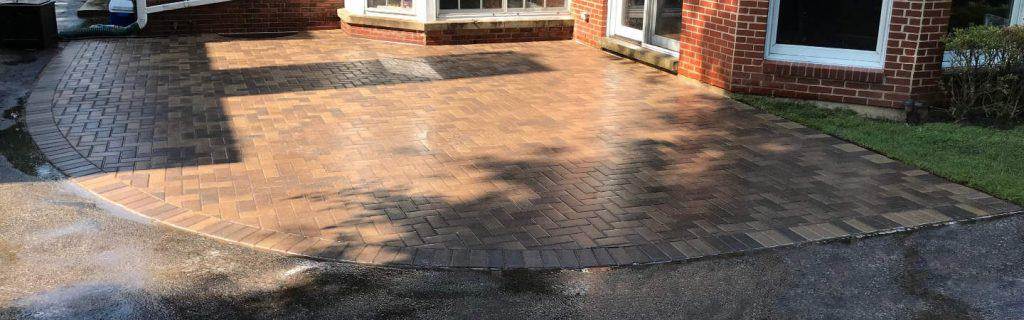
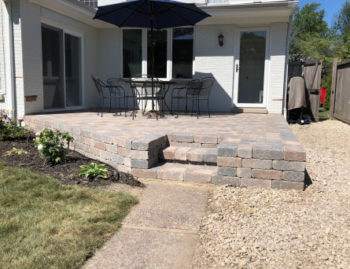
Over a paver patio. Pavers are a wearing surface, not a structural one. The honest method is to lift the pavers at the post positions, pour piers underneath and reset the field around the post bases so the patio reads as one surface. Bolting post bases straight onto pavers sends every wind load into a sand-set field, and a pergola is a sail.
Over a concrete slab. A sound slab is the friendliest base there is; posts can be set into it or bolted down with heavy bases. Settle thickness, reinforcement and whether the slab was built with frost in mind, because anchoring a rigid structure to a slab that heaves gives you a structure that heaves.
On open lawn. No existing surface means four poured piers and no shortcuts, plus a decision about what goes underneath: gravel, a new paver field, a walkway tying back to the house, or turf.
Over an existing raised platform. A pergola can be built over one, but only if its framing and footings were sized to carry a structure on top. That is a load question answered by looking at the framing, not the surface.
Attached or Freestanding?
An attached pergola replaces the two back posts with a beam fastened to the house. Fixr describes it that way: the front posts go in as on a freestanding structure, and a beam is attached at the height of the back frame, needing less material and less digging because there are no back posts to sink. HomeGuide agrees that attached pergolas have fewer columns, reducing material costs.
| Placement | Installed cost | Trade-off | Source |
|---|---|---|---|
| Attached to the house | $1,700–$5,000 | Fewer posts, less excavation; the wall carries the load and must stay watertight at the tie-in | Fixr |
| Over an existing patio | $1,900–$6,500 | Uses a surface you already have; anchoring depends on how the patio was built | Fixr |
| Freestanding | $2,500–$6,500 | Goes anywhere in the yard; needs four poured footers | Fixr |
In practice the door decides. Attached structures shade the transition from house to yard, which is why they show up over back doors and outdoor kitchens. Freestanding structures put shade where the sun actually is at 4 p.m., which is rarely against the house.
Materials That Hold Up in Chicago Winters
| Material | Cost per sq ft | How it behaves outdoors here | Source |
|---|---|---|---|
| Aluminum | $10–$30 | Weather-resistant, low-maintenance; kits $500–$1,500 | Angi, HomeGuide, Fixr |
| Vinyl | $10–$30 | Fade-resistant, but Fixr notes it can crack in extreme cold and suits moderate climates | Angi, HomeGuide, Fixr |
| Pressure-treated lumber | About $10–$11 | Value option; treatment resists rot but not water uptake | Fixr, UMass BCT |
| Cedar | $25–$35 (Angi) · $25–$40 (HomeGuide) | Naturally moisture- and insect-resistant, takes stain well, can crack | Angi, HomeGuide, Fixr |
| Redwood | $40–$50 | Insect- and rot-resistant, durable in severe weather; harder than cedar, so Fixr says it lasts longer | Angi, HomeGuide, Fixr |
| Steel | Kits $500–$1,500 | Uncommon; heavier than aluminum and, per Fixr, more prone to rust | Fixr |
Two points matter more here than the price column. The first is heartwood. Building and Construction Technology at UMass Amherst puts it plainly: only the heartwood of certain species is naturally decay resistant, and untreated sapwood of virtually all species has very little decay resistance. Cedar is on their list of decay-resistant woods, along with old-growth redwood, white oak and locust. Buying "cedar" is not the same as buying cedar heartwood, and on a structure meant to stand for decades, that distinction is worth asking about by name.
The second is water, not rot. The same source notes pressure treating makes wood rot resistant but not water resistant, so treated lumber still absorbs and loses moisture and moves, cracks, twists and cups. Their remedy: a water-repellent coat on all surfaces before installation, corrosion-resistant fasteners, brush treatment on every cut, and annual retreatment. That is the upkeep reality of a wood pergola through freeze-thaw cycles.
What the Work Costs in the Chicago Area
Published 2026 ranges vary by source because they measure different things: kit assembly on an existing base is a different project from a custom build. These are market ballparks, not a quote for your yard.
| Size | Kit installed | Custom build | Source |
|---|---|---|---|
| 10' x 10' | $1,000–$4,000 | $3,000–$6,500 | HomeGuide |
| 12' x 12' | $1,450–$5,750 | $4,300–$9,350 | HomeGuide |
| 12' x 20' | $2,400–$9,600 | $7,200–$15,600 | HomeGuide |
Angi's size table, which blends both approaches, puts a 10x10 at $3,000 to $6,000 and a 12x12 at $4,300 to $8,600. Fixr's national average is $4,500 for a 10x12 cedar pergola, inside a range of $1,900 to $6,500, with a low end of $1,000 for a professionally assembled aluminum kit and a high end of $15,000 for custom teak. Per square foot, HomeGuide lands at $10 to $40 installed for kit assembly on an existing foundation and $30 to $65 for a custom build.
Add-ons that most often move a quote here: a new slab at $5 to $10 per square foot, a foundation allowance HomeGuide puts at $4 to $30 per square foot extra, lighting at $80 to $300 per fixture, an outdoor outlet at $180 to $350, and a finish coat at $2 to $5 per square foot.
Project Timeline by Scope
| Scope | What drives the schedule | Verified marker |
|---|---|---|
| Kit on an existing patio or slab | Kit delivery, then a short assembly window | Fixr: assembly needs two or more people |
| Custom build on an existing surface | Lumber order, on-site cutting, finish cure | HomeGuide: $50–$120 per hour |
| New footings plus custom build | Utility locates, excavation, concrete pour and cure before framing | Fixr: four footers dug and poured for a freestanding structure |
| Anything needing village review | Plan review before work can begin | Skokie: small projects such as fences or garages are usually reviewed in 3–5 business days |
Anything that triggers a Zoning Board of Appeals, Plan Commission or Appearance Commission step, which Skokie flags for larger projects, adds meeting-calendar time rather than review-desk time. Concrete is season-sensitive here too, one reason spring and summer book up first across Skokie, Evanston, Wilmette and Winnetka.
What to Expect From the Crew
- A scaled drawing, not a sketch. Skokie requires straight-line, scaled and dimensioned construction drawings for a structure built on site, and the manufacturer's instructions for a kit.
- A written anchoring method. Skokie's pergola guidance requires information on how the pergola is attached to a patio or to piers. That belongs on the drawing, not decided with a shovel in hand.
- Utility locates before excavation. Non-negotiable on pier work.
- An itemized estimate. Materials, labor, footings, permit handling and finish broken out, so a change in scope is visible instead of absorbed.
- Who pulls the paperwork. Settle this at estimate stage. Thresholds, height limits and setbacks differ by village, and are covered in our guide to permit rules for a pergola in Chicago, Skokie and Evanston.
Installing a Pergola in Chicago: FAQ
How deep do pergola footings have to go in the Chicago area?
The Chicago Building Code protects foundations and permanent supports from frost, and the first method it lists is extending at least 42 inches below final grade. The municipal code states the same depth as three feet six inches below the adjoining ground surface. The code exempts some small free-standing structures, so confirm the depth with the building department reviewing your plan.
How much does it cost to install a pergola near Chicago?
Angi puts professional installation at $2,118 to $6,433 nationally, around $4,253 for a 100-square-foot structure, and reports a higher Chicago-area range of $2,900 to $8,858 with an average of $5,704. Fixr's national average is $4,500 for a 10x12 cedar structure. Size, material and kit-versus-custom decide where a project lands.
Can a pergola be anchored to an existing paver patio?
Often, yes. Fixr notes that depending on the patio material, a pergola may be anchored to a stone or concrete patio without separate footers, or may need footers dug and poured. Because pavers are a wearing surface, the usual method is lifting them at the post locations and pouring piers underneath.
Do I need a concrete slab under a pergola?
No. HomeGuide notes posts can be cemented into a concrete slab for maximum durability and prices a new slab at $5 to $10 per square foot, with Angi putting a 100-square-foot slab at about $600. A freestanding structure on open ground uses four poured concrete footers instead, per Fixr.
Is cedar or aluminum the better pergola material for Chicago weather?
Both work; they fail differently. Cedar is naturally moisture- and insect-resistant and takes stain well, but UMass Amherst's building technology program notes only heartwood carries that resistance, and wood here needs a water-repellent finish and annual upkeep. Aluminum runs $10 to $30 per square foot and is low-maintenance. Vinyl is the one to think twice about: Fixr notes it can crack in extreme cold.
Is an attached pergola cheaper than a freestanding one?
Usually. Fixr prices an attached structure at $1,700 to $5,000 installed versus $2,500 to $6,500 freestanding, because it uses a beam on the house instead of two back posts and needs less material and digging. The trade-off is that the wall carries that load and has to stay watertight at the tie-in.
Can a pergola go over an existing patio or raised platform?
Yes, and it is one of the most common ways a pergola gets added to a finished yard. The condition is structural: the surface and its supports have to carry the weight and resist uplift. On a patio that is a question about how the patio was built; on a raised wood platform, about the framing underneath.
How long does pergola installation take?
The build itself is short relative to the whole project. Fixr notes assembly needs a crew of two or more. The calendar is usually set by everything around it: village plan review, which Skokie lists at 3 to 5 business days for small projects, plus material lead time and, on pier work, excavation and concrete cure before framing starts.
Planning a Pergola for Your Yard?
Published ranges tell you the market. The number for your yard depends on what is already there: the surface the posts land on, how the ground drains, how far the beams span, and what your village asks for. R & G Almanza Landscape Inc is a family-owned, insured crew that has built hardscapes, patios and outdoor structures across Skokie, Evanston, the North Shore and the greater Chicago area since 1999. Contact us to request an estimate for your property.
Call R & G Almanza Landscape at (847) 869-8584 to talk through your pergola project.