Most retaining wall repairs in the Chicago area run $450 to $950, with an average near $700, per Angi's 2026 cost data shown for the Arlington Heights, IL area; HomeGuide puts repairs at $100 to $1,500 and Fixr at $250 to $1,250 nationally. Removing and rebuilding the same wall is a different order of magnitude: $6,000 to $14,000 for a 50-foot, 4-foot-tall wall, per HomeGuide. What decides which one you are facing is not the size of the crack. It is whether the base under the wall and the drainage behind it are still doing their job.
A wall that leans, bulges or cracks is showing a symptom, and the same symptom can come from three different problems: water with nowhere to go, a base that was never deep enough, or a wall now holding more soil than it was built for. Below is how to read each symptom, how repair and rebuild compare by wall type, what published guides say each fix costs, and when a permit or an engineer enters the picture. If you already know your wall needs work, our retaining wall contractors page covers how we build and rebuild walls across Skokie, Evanston and the greater Chicago area.
What a Leaning, Bulging or Cracked Wall Is Telling You
Name the symptom precisely first: a wall tipping forward as one piece is a different problem from a wall with a bulge in the middle. The figures below are published 2026 ranges, not a quote for your wall.
| What you see | What it usually means | Common fix | Published cost |
|---|---|---|---|
| Whole wall tipping forward at the top | Saturated soil is overturning the wall; the base is losing its grip | Tiebacks or helical anchors | $250-$1,500 per project (Fixr) |
| Bulge mid-wall, the ends still straight | One zone is carrying more water pressure than the rest | Anchoring plus drainage correction | $275-$1,200 (Angi); $200-$1,500 (HomeGuide) |
| Stair-step or vertical cracks in block or brick | Movement in the base below, or one section settling | Reinforcing, repointing, base repair | $335-$1,100 (Angi); $150-$400 per crack (Fixr) |
| Water seeping through the face, or white powder on it | Water is exiting through the wall because it has no other route out | Add drainage, then patch | Seeping $220-$990; efflorescence $220-$480 (Angi) |
| Soil sinking or washing out behind the wall | Fines are migrating through the wall; the drainage layer is clogged or was never built | Rebuild the drainage layer and backfill | Adding drainage $50-$80 per sq ft (HomeGuide) |
Leaning or tipping forward
When the top of a wall has moved out but the wall is still in one piece, the soil behind it is winning. Fixr prices repair of a leaning wall at $250 to $1,500 per project and names the standard fix as tiebacks, or deadman anchors: a rod fixed to the wall at one end and to a stable mass buried in the slope at the other.
Bulging or bowing in the middle
A bulge in one part of a wall while the rest holds its line is the clearest sign water is concentrating there. Angi puts bowing or leaning repair at $275 to $1,200 and points to anchoring, with steel rebar at $2.50 to $5 per square foot. Fixing the bulge without fixing why water pooled there is how the same repair gets paid for twice.
Cracks, and which kind matters
Fixr prices crack repair at $150 to $400 and lists the causes as harsh weather, moving soil, poor design, pressure from wet soil, and inadequate drainage. Angi groups cracking and crumbling at $335 to $1,100. Fine cracks in a plumb wall are a patch; wide cracks in a wall that has already moved are structural.
Washouts, sinkholes and efflorescence
Erosion control is the whole point of a retaining wall, so soil disappearing behind one means it has stopped doing its job. A dip in the lawn along the top, or a void you can feel with a probe, means backfill is migrating out. The white bloom on a block face is efflorescence: Angi describes it as salt carried by water that evaporates and leaves residue, at $220 to $480, and names the real fix as addressing the moisture source.

Why Walls Fail Here: Water, Frost and a Base That Was Never Right
Five causes account for most failed walls in Skokie, Evanston and the North Shore.
- Hydrostatic pressure. Fixr states it plainly: drainage is essential because water usually cannot pass through the wall, and without it, pressure builds in the soil behind the wall and makes it more likely to break or crack.
- No drainage layer at all. Plenty of older walls here were stacked straight against native soil with no stone, pipe or outlet. They hold until a wet spring.
- Frost heave. Water trapped in the ground expands as it freezes and lifts whatever sits in the frozen layer. HomeAdvisor notes poured concrete walls may need an extra $30 to $100 per linear foot for footings and pilings on walls over four feet high or in freeze-thaw climates, specifically to prevent cracking.
- A base or footing that was never deep enough. Angi lists shallow footings first among the signs a wall is not worth saving.
- Tree roots and added load above the wall. A root wedging between courses, or new fill, a driveway or a patio above the wall, changes the load it was built for.
Water and frost do the most damage in this climate, and they work together: the drainage failure puts water in the soil, and winter turns it into a jack. That mechanism, and how a correctly built wall defeats it, is covered in our guide to why retaining walls fail in Chicago.
Retaining Wall Repair or Rebuild, by Wall Type
The answer changes with the material, because each one fails in its own way.
| Wall type | Usually repairable when | Usually a rebuild when | Published repair cost |
|---|---|---|---|
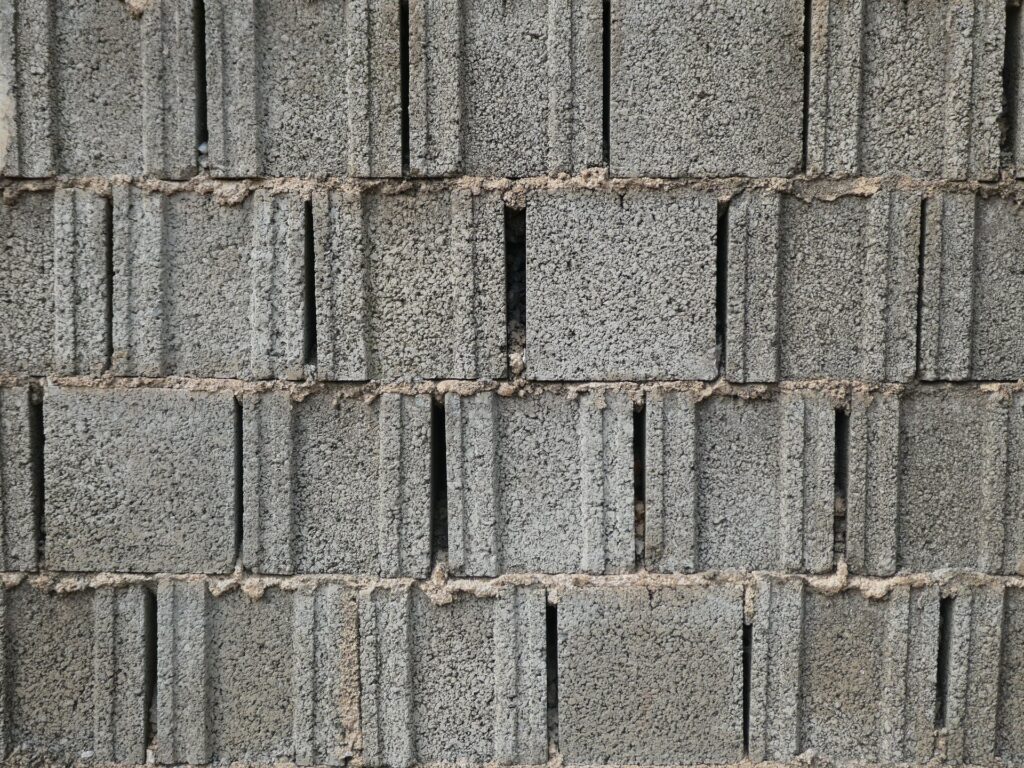
| Concrete or cinder block (segmental) | Courses have shifted but the base is level | The base has settled, units are cracked through, or the lean runs full height | Cinder block $300-$1,000; concrete block $500-$1,250 (Fixr); $20-$45 per sq ft (HomeGuide) |
| Brick | Mortar is failing but the wall is still plumb | The face has bowed or cracks run through the units | $300-$1,250 (Fixr); $8-$18 per sq ft (Angi) |
| Timber or railroad tie | A few members are rotted and the rest is sound | Rot has spread or the buried anchors have gone | Timber $250-$1,100; railroad tie $200-$1,100; rot repair $40-$60 per sq ft (Fixr) |
| Poured concrete | Cracks are narrow and the wall is still plumb | The wall has rotated or the footing has moved | $600-$1,100 (Fixr); $20-$45 per sq ft (HomeGuide) |
| Natural stone or boulder | Individual stones have pushed out of a sound face | The face has lost its batter or the core has washed out | Natural stone $500-$1,250; limestone $750-$1,600 (Fixr); $15-$45 per sq ft (Angi) |
Three published rules decide the rest. Angi's position is that repair is the right route when it comes in at least 50% to 75% below the price of a new build. Fixr advises replacement when damage is extensive or the wall is over 50 years old. And Angi names four signs a wall is past saving: shallow footings, no weep holes, significant leaning, and wide cracks. Angi also warns that an old wall should not be removed without another stabilization plan in place, because the slope does not wait.
The rebuild side of the ledger: Fixr prices rebuilding a section at $70 to $125 per linear foot. HomeGuide splits a full replacement into $2,000 to $4,000 for demolition plus $4,000 to $10,000 for the new wall, $6,000 to $14,000 total on a 50-foot by 4-foot wall; Angi's figure for that same wall is $7,000 to $24,000. A new wall with no demolition runs $3,192 to $9,208 nationally and $2,357 to $6,262 in the Arlington Heights, IL area (HomeAdvisor).
What the Published Repair Numbers Look Like
Guides price repairs by method, and the units differ between publishers: Fixr quotes several fixes per linear foot where Angi and HomeGuide quote the same fixes per square foot of wall face. Compare like for like.
| Repair method | Published cost | Source |
|---|---|---|
| Reinforce (new mortar and concrete, thicken the base) | $50-$75 per linear foot | Fixr |
| Straighten | $60-$80 per linear foot | Fixr |
| Anchor or tieback | $60-$80 per linear foot (Fixr); $60-$80 per sq ft (HomeGuide) | Fixr, HomeGuide |
| Add drainage | $70-$90 per sq ft (Fixr); $50-$80 per sq ft (HomeGuide) | Fixr, HomeGuide |
| Weep holes drilled through the wall | $60-$75 per sq ft | Angi |
| Rebuild a section | $70-$125 per linear foot | Fixr |
| New footings | $18-$50 per linear foot (Angi); $18-$55 installed (HomeGuide) | Angi, HomeGuide |
Labor is quoted three ways too: $50 to $200 per hour plus a $50 to $100 call-out fee (Fixr), $50 to $109 per hour for masonry and landscaping pros (Angi), and $50 to $75 per hour (HomeGuide). A structural engineer runs $100 to $220 per hour (Angi, HomeGuide), and an inspection costs $150 to $300, recommended every three to five years.
Permits, Engineering and When to Call Your Village
Repairs usually sit below the permit threshold; rebuilds usually do not. HomeGuide's position is that you typically do not need a permit to repair a retaining wall, but you might if the work changes the wall's footprint, height or structure, with permits and inspections at $50 to $450 depending on location. Angi notes that in most cities walls under four feet in height are exempt from permits, and prices permits for large repair projects at $50 to $200. HomeAdvisor's rule is that walls more than four feet high require a structural engineer, at $350 to $750.
Locally, the Chicago Building Code is explicit about what a retaining wall has to do. Section 1807.2 requires retaining walls to be designed for stability against overturning, sliding, excessive foundation pressure and water uplift, with a minimum safety factor of 1.5 against sliding and 2.0 against overturning. That is the standard a rebuild is measured against, and why an engineer gets involved on taller walls.
Thresholds differ village to village across the North Shore, and the Village of Skokie's building permit page states that most construction and home improvement projects there require a permit. Check with your village before work starts, and ask about height measured from the bottom of the footing and whether the wall changes drainage onto a neighboring lot.
How We Approach a Failing Wall
- Inspection first. The base and its embedment, whether a drainage outlet exists and is flowing, what the backfill is made of, and where roof and surface water goes in a storm.
- Drainage correction. On most failing walls here the water is the cause and the lean is the symptom, so the drainage layer and its outlet get fixed either way.
- Repair where the base is sound. Resetting courses, repointing, replacing rotted members and anchoring all work when the foundation has not moved.
- Rebuild where it is not. When the base has settled or the wall has rotated, rebuilding to a correct base depth, drainage layer and reinforcement is the repair that lasts.
R & G Almanza Landscape Inc is a family-owned, insured landscape and masonry crew based in Skokie, working across Skokie, Evanston, the North Shore and the greater Chicago area since 1999, more than 25 years.
Repair or Rebuild: Questions Chicago Homeowners Ask
Can a leaning retaining wall be repaired, or does it have to come down?
Usually it can be repaired. Fixr's answer is that leaning walls can generally be strengthened by transferring force back to the base and adding anchors or tiebacks, at $250 to $1,500 per project. The exception is a wall whose footing has moved or whose base was too shallow to start with; Angi lists shallow footings and significant leaning among the signs a wall is past saving.
How much does it cost to fix a retaining wall?
Angi's 2026 cost data for the Arlington Heights, IL area shows a normal range of $450 to $950, averaging $700, low $200 and high $1,200. HomeGuide's national range is $100 to $1,500 and Fixr's is $250 to $1,250, averaging $750. Where a wall lands depends on the material, the damaged area, and whether drainage has to be rebuilt behind it.
Is it cheaper to repair or rebuild a retaining wall?
Repair is almost always cheaper in the moment. Angi's guidance is that repair is the right route when it costs at least 50% to 75% less than a new build, and Fixr suggests replacement once damage is extensive or the wall is over 50 years old. Removing and replacing a 50-foot, 4-foot wall runs $6,000 to $14,000 (HomeGuide) against $250 to $1,250 for a typical repair.
Why is my block wall bulging in the middle?
A bulge in one section while the ends hold their line almost always means water pressure is concentrated there. Water that cannot drain out of the backfill pushes on the weakest part of the wall. Angi prices bowing or leaning repair at $275 to $1,200 and points to anchoring, but the anchor only holds if the water behind the wall is given a route out at the same time.
Do I need a permit to repair a retaining wall in the Chicago area?
It depends on your village and the scope. HomeGuide notes that repairs typically do not require a permit unless they change the wall's footprint, height or structure, with permits and inspections at $50 to $450. Skokie's building permit page says most construction and home improvement projects there require a permit, so check with your village before work begins.
How long should a retaining wall last?
Fixr puts the average life of a retaining wall at 50 to 100 years depending on material, soil and climate, and treats a wall over 50 years old as a candidate for replacement rather than repair when damage is extensive. Fixr also recommends an inspection every three to five years at $150 to $300, more often for older walls or walls facing a public right-of-way.
What does efflorescence on a retaining wall mean?
The white residue on a block or brick face is salt left behind when the water carrying it evaporates, which means water is moving through the wall. Angi prices the repair at $220 to $480 and describes the real fix as addressing the moisture source, often a moisture barrier plus a drain system. Fixr's range is $150 to $850 and notes weep holes or drain pipes are often part of the answer.
Get a Straight Answer on Your Wall
A wall that has started to move rarely stops on its own, and the difference between a $700 repair and a $14,000 rebuild is usually how long it was left. The judgment worth paying for is deciding correctly whether the base and the drainage can be saved. Call R & G Almanza Landscape at (847) 869-8584, or contact us to have your wall looked at before the next freeze-thaw season works on it.